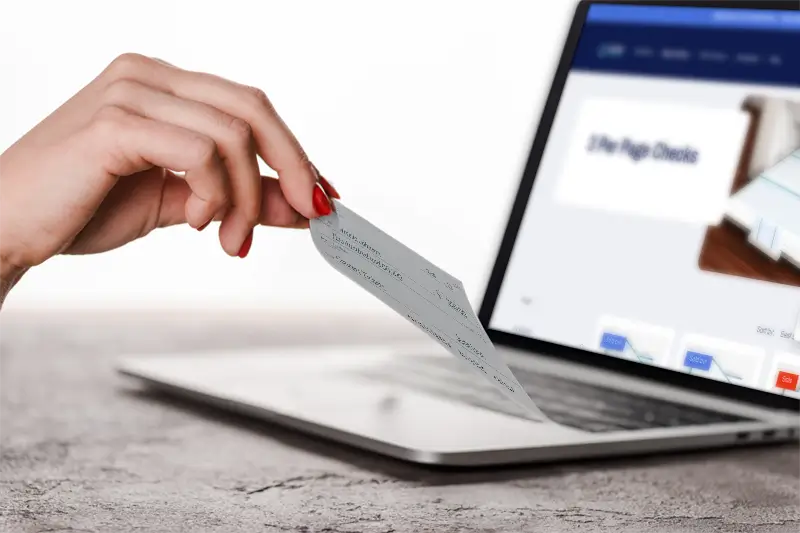
Yes, you can print your own checks at home, for personal and business accounts alike. No law says checks must come from your bank. What matters is that the check carries the right information and a MICR line that bank equipment can read. This guide explains what makes a home-printed check valid, what you need, how to print one step by step, and when ordering checks still makes more sense.
To print your own checks at home:
- Get blank check stock and a laser printer with a MICR toner cartridge.
- Install check printing software and enter your bank name, routing number and account number, copied from an existing check.
- Choose a layout, print a test on plain paper, then print on the check stock and sign.
It is legal, and banks accept home-printed checks when the MICR line is correct and readable.
Is it legal to print your own checks?
Yes. Under the Uniform Commercial Code, which every state has adopted in some form, a check is simply a written order to pay a set amount, drawn on a bank and payable on demand. Nothing in that definition says who has to print the paper. Your bank is not the only source of valid checks, and many businesses have printed their own for decades.
What a bank does care about is whether its equipment can process the check. Checks are sorted and cleared by reading the MICR line at the bottom, printed in magnetic ink in a standard font called E-13B. The banking industry’s standards body, Accredited Standards Committee X9, publishes the rules for the font and where the MICR line goes on the page. A home-printed check that follows them clears like any other. One that does not may be rejected or keyed in by hand, which slows it down.
One more check: printing your own checks is legal, but writing a check on an account that is not yours, or altering one, is fraud. Use your own account details, and tell your bank if you are switching to printed checks so a new-looking check is not flagged.
What you need to print checks at home
- Blank check stock. Use real check paper, not copy paper. Check stock is heavier and carries security features that make copying and alteration harder. Pick the layout that matches your use: personal-size checks, or 8.5×11 sheets with the check at the top, middle or bottom, or three checks per page. Our guide to blank check stock vs pre-printed checks compares them.
- A laser printer with MICR toner. Regular toner prints a MICR line that looks right but carries no magnetic signal, so some bank equipment cannot read it. The MICR toner FAQ explains the difference.
- Check printing software. It stores your bank details, prints the MICR line in the E-13B font, and lines everything up on the check stock. Software such as MultiCHAX also prints from accounting programs like QuickBooks.
- Your bank details. The routing number and account number from the bottom of one of your current checks, or from your bank.
The parts of a check you print
Software fills in your name, address, bank name and the MICR line. You or your accounting program supply the date, payee, amount and memo for each check, and the check is signed by hand or with a stored signature image. If you write any checks by hand, our guide on how to write a check covers the amount in words.
How to print checks at home, step by step
- Install the software and create an entry for each bank account you write checks from.
- Enter your bank details: bank name, routing number, account number and the next check number. Copy them carefully from an existing check; one wrong digit sends the check to the wrong account or gets it rejected.
- Choose a layout that matches your check stock, and add your name and address, plus a logo if you like.
- Print a test on plain paper. Hold it against a sheet of check stock to make sure every field and the MICR line land where they should. Adjust and repeat until they do.
- Load the check stock in the right orientation, swap in the MICR toner cartridge if you keep a separate one, and print.
- Sign and record each check, and keep your register up to date so your balance stays accurate.
Before you rely on printed checks for important payments, deposit one small check to yourself or a family member to confirm your bank processes it without trouble.
Ordering checks vs printing your own
| Order from a bank or check printer | Print your own | |
|---|---|---|
| Setup | None; checks arrive ready to use | Software, MICR toner and a one-time alignment |
| Getting new checks | Reorder and wait for delivery | Print as many as you need, when you need them |
| Several accounts | A separate supply for each account | One supply of blank stock for every account |
| If checks are stolen | Thieves get your account and routing numbers | Blank sheets carry no account details |
| Design | Pick from the vendor’s designs | Your own logo, layout and signature image |
| Best for | A few handwritten checks a year | Regular check writers, small businesses, several accounts |
If you write only a handful of checks a year, ordering a box is simpler. Once you write checks every month, run more than one account, or want your own design, printing your own pays off. Our guide to designing and printing custom checks covers the design side in detail.
Types of checks your bank offers
Not every check can or should be printed at home. Here is how the common types compare:
- Personal checks draw on your own checking account. These are the checks you can print yourself, usually wallet-size or three to a page.
- Business checks draw on a business account and are usually larger, often on 8.5×11 sheets with a stub. Small businesses commonly print these from their accounting software.
- Cashier’s checks are drawn on the bank’s own funds and issued by the bank. You cannot print one yourself; a printed “cashier’s check” from anyone but a bank is a red flag.
- Certified checks are personal checks the bank has guaranteed. The bank certifies them at the counter.
- Money orders are prepaid payment orders sold by banks, the Postal Service and retailers.
For the last three, see our comparison of cashier’s checks and money orders.
Keeping printed checks secure
- Buy check stock with security features such as microprinting, a watermark and chemically reactive paper. Our guide to check security features explains each one.
- Lock up the stock and your signature file. Blank stock is safe until your software prints on it, so protect the software with a password too.
- Mail checks inside the post office rather than leaving them in an unattended mailbox, to reduce the risk of check washing.
- Use Positive Pay if your business bank offers it, and reconcile your account every month. Our check fraud guide covers both.
What about free online check printing?
Some websites let you design and print checks for free or for a small fee, or print and mail them for you. Before you use one, check three things: that it prints a correct E-13B MICR line (you still need MICR toner if you print at home), how it stores your bank details, and what it charges per check or per month once the trial ends. Free check templates without a proper MICR line are the most common reason a bank rejects a home-printed check.
Troubleshooting home-printed checks
The bank rejected the check
Compare the routing and account numbers on the check with your bank’s, and confirm the MICR line was printed with MICR toner in the right position. Your bank can tell you why it was returned.
Mobile deposit will not accept it
Mobile deposit apps read the MICR line from a photo. Check that the line is crisp, complete and not too close to the edge, and that the check is on real check stock.
Fields print in the wrong place
Run the alignment test on plain paper again and adjust the position in your software. Make sure the paper size and check position in the software match the stock in the printer.
Printing your own checks: FAQ
Can you print your own checks?
Yes. It is legal to print your own personal or business checks, as long as they use your own account details and a MICR line banks can read.
Can you print checks at home on a regular printer?
You need a laser printer. For the MICR line, use a MICR toner cartridge; regular toner and inkjet ink do not carry the magnetic signal some bank equipment reads.
Can I print checks on plain paper?
Use check stock instead. It is made for check processing, carries security features, and is what banks expect. Checks on copy paper are easier to forge and more likely to be refused.
What personal check printing software should I use?
Look for software that prints the E-13B MICR font, supports your check layout, handles more than one bank account and protects your signature. MultiCHAX does all of this and also prints from QuickBooks and other accounting programs.
Can I print a cashier’s check online?
No. A cashier’s check is issued by a bank from its own funds. Any service offering to let you print one yourself is not legitimate.
Sources
- Uniform Commercial Code § 3-104, negotiable instrument and check, Cornell Law School LII
- ANSI X9.100-160-1-2021, Magnetic Ink Printing (MICR) Part 1: Formatting MICR, ANSI Webstore
- ANSI X9.100-20-2021, E-13B MICR character specifications, ANSI Webstore
- The Federal Reserve Payments Study: 2022 Triennial Initial Data Release, Board of Governors of the Federal Reserve System
