
What is a Remotely Created Check (RCC) and How Does It Work?
In the world of payments, you may have heard the term “remotely created check,” “check by phone,” or “demand draft.” These all refer to the same powerful payment instrument: a check that is created by the payee on behalf of a customer who has given them authorization.
Unlike a regular check, which is created and signed by the person paying, an RCC is created by the person receiving the payment. This unique workflow makes it an incredibly useful tool for businesses that need to accept payments over the phone or online without the high fees of credit cards.
How Does a Remotely Created Check Work?
The process is simple, secure, and legally recognized under U.S. banking law.
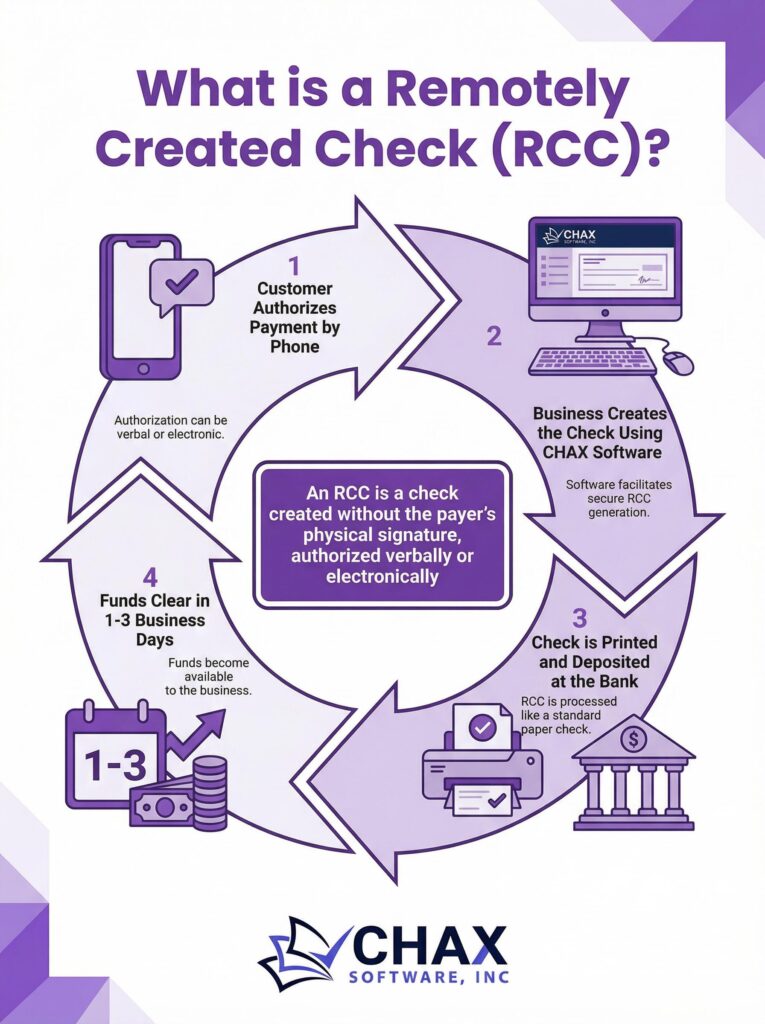
Step 1: The Customer Gives Authorization
The process begins with the customer giving the business explicit authorization to create a check on their behalf. This authorization is typically given over the phone or through a secure web form. The customer provides the same information they would write on a regular check:
- Their name and address
- Their bank’s name
- Their bank account type (checking or savings)
- The bank routing number
- The bank account number
- The amount of the payment
It is a best practice, and often a legal requirement, to record the phone call or save the web form submission as proof of authorization.
Step 2: The Business Creates the Check
Using a specialized check-by-phone software, the business enters the customer’s information and the payment amount. The software then generates a complete, legally valid check.
Instead of a signature line, the check will have a statement such as “Authorized by Drawer” or “Signature on File.” This indicates that it is a remotely created check and is a perfectly acceptable substitute for a handwritten signature under Regulation CC of the Check 21 Act.
Step 3: The Business Deposits the Check
The business then prints the check using a standard laser printer. This printed check is a legal and negotiable instrument. It can be deposited at the bank just like any other check:
- Mobile Deposit: Using a banking app on a smartphone.
- Desktop Scanner: Using a check scanner for remote deposit capture (RDC).
- In-Person: By taking it to a bank teller or ATM.
Why is an RCC a Powerful Tool for Businesses?
Remotely created checks offer a unique combination of benefits that other payment methods can’t match:
- Accept Payments Instantly: You can get a customer’s payment information over the phone and have a deposit-ready check in your hands in minutes. This eliminates the classic excuse, “The check is in the mail.”
- No Credit Card Fees: RCCs are processed through the banking system just like regular checks. There are no expensive percentage-based interchange fees, which can save your business a significant amount of money compared to credit card processing.
- Ideal for Recurring Payments: It’s a perfect solution for setting up recurring billing for services like gym memberships, storage unit rentals, or subscription services, especially for customers who do not want to use a credit card.
- Reduces Collections: For businesses in the debt collection industry, RCCs are an essential tool for securing payment during a collection call.
By understanding and utilizing remotely created checks, businesses can streamline their collections process, reduce payment processing fees, and gain a powerful tool for managing their accounts receivable. A dedicated check printing software with check-by-phone capabilities is the key to unlocking this efficient payment method.