
Accounts Payable Workflow Best Practices for Small Businesses
For any small business, managing accounts payable (AP) effectively is crucial for maintaining healthy cash flow, good vendor relationships, and financial accuracy. A disorganized AP process can lead to late payment fees, missed discounts, and a clouded view of your company’s financial health. Implementing a structured workflow with clear best practices is essential.
This guide outlines the key best practices for creating a streamlined and secure accounts payable workflow.
What is an Accounts Payable Workflow?
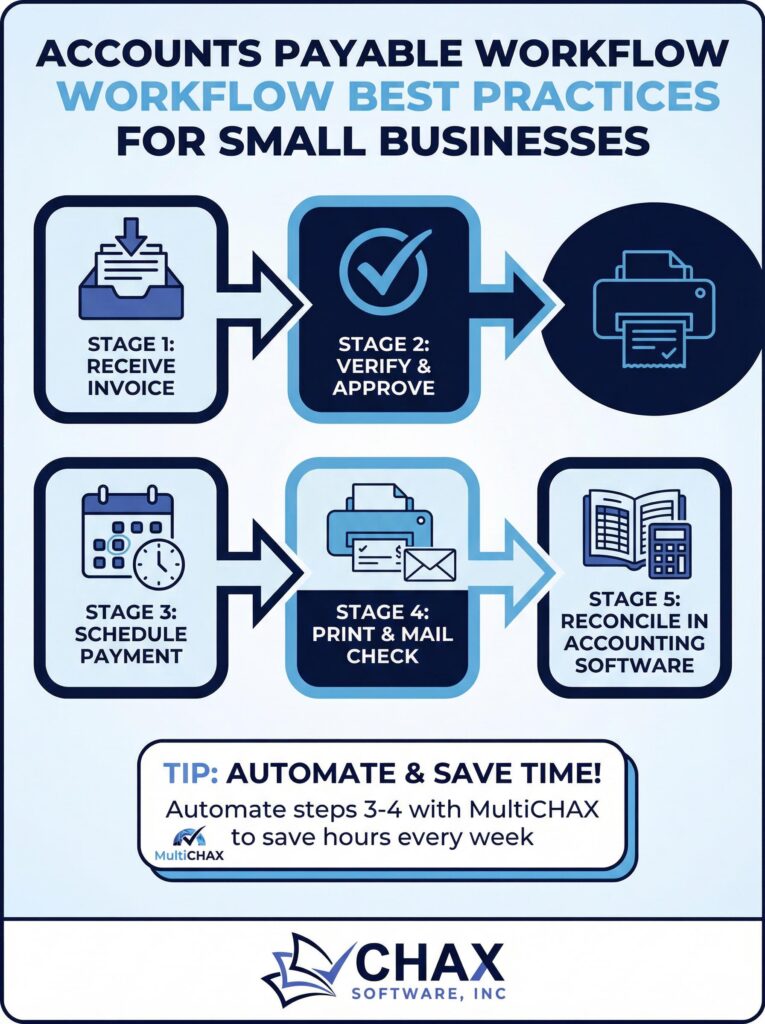
The AP workflow is the end-to-end process your company uses to receive, approve, and pay the bills it owes to vendors and suppliers. A typical workflow includes:
1. Invoice Receipt: Receiving the bill from a vendor.
2. Invoice Verification: Confirming the goods or services were received and the invoice is accurate.
3. Approval: Getting authorization from the appropriate manager to pay the bill.
4. Payment Processing: Issuing the payment via check, ACH, or credit card.
5. Record Keeping: Recording the payment in your accounting software and archiving the documentation.
Best Practices for a Modern AP Workflow
1. Centralize Invoice Receipt
Instead of having invoices sent to various people across the company, establish a single point of entry. This could be a dedicated email address (e.g., ap@yourcompany.com) or a specific person responsible for collecting all incoming bills. This prevents invoices from getting lost or forgotten on someone’s desk.
2. Implement a Three-Way Match
This is a fundamental internal control. Before paying a bill, you should match three documents:
- The Purchase Order (PO): The document you sent to the vendor authorizing the purchase.
- The Receiving Report: The document confirming the goods or services were received.
- The Vendor Invoice: The bill requesting payment.
If the details on all three documents match (item, quantity, price), you can be confident the invoice is legitimate and accurate.
3. Segregate Duties
To prevent fraud, the person who approves a payment should not be the same person who processes the payment. For example, a department manager might approve an invoice, but only a member of the finance team should be able to print the check or initiate the ACH payment. This separation of duties is a critical security measure.
4. Digitize and Automate Your Payment Process
Manual, paper-based processes are slow, inefficient, and insecure. Modern businesses should leverage technology to streamline their AP workflow.
- Move Away from Pre-Printed Checks: Instead of using expensive and insecure pre-printed check stock, use a check printing software like MultiCHAX to print checks on demand onto secure, blank check stock. This reduces costs and minimizes the risk of check fraud.
- Use Digital Signatures: For efficiency, use a software solution that allows for password-protected digital signatures. This saves time for authorized signers and allows the payment process to continue even if they are out of the office.
- Automate Record Keeping: Use an accounting system like QuickBooks or Sage 50 that automatically records payments and simplifies bank reconciliation.
5. Establish Clear Approval Hierarchies
Define who is authorized to approve payments and up to what amount. For example, a project manager might be able to approve invoices up to $1,000, while anything over that amount requires approval from a director or VP. This ensures proper oversight for significant expenditures.
6. Maintain a Vendor Master File
Keep a centralized and up-to-date record of all your approved vendors, including their contact information, payment terms, and tax ID numbers. This helps prevent payments to fraudulent or incorrect entities and makes year-end 1099 processing much easier.
By implementing these best practices, you can transform your accounts payable process from a chaotic cost center into a streamlined, secure, and strategic part of your financial operations. Using a tool like a QuickBooks check printing software is a key component of this modernization.