
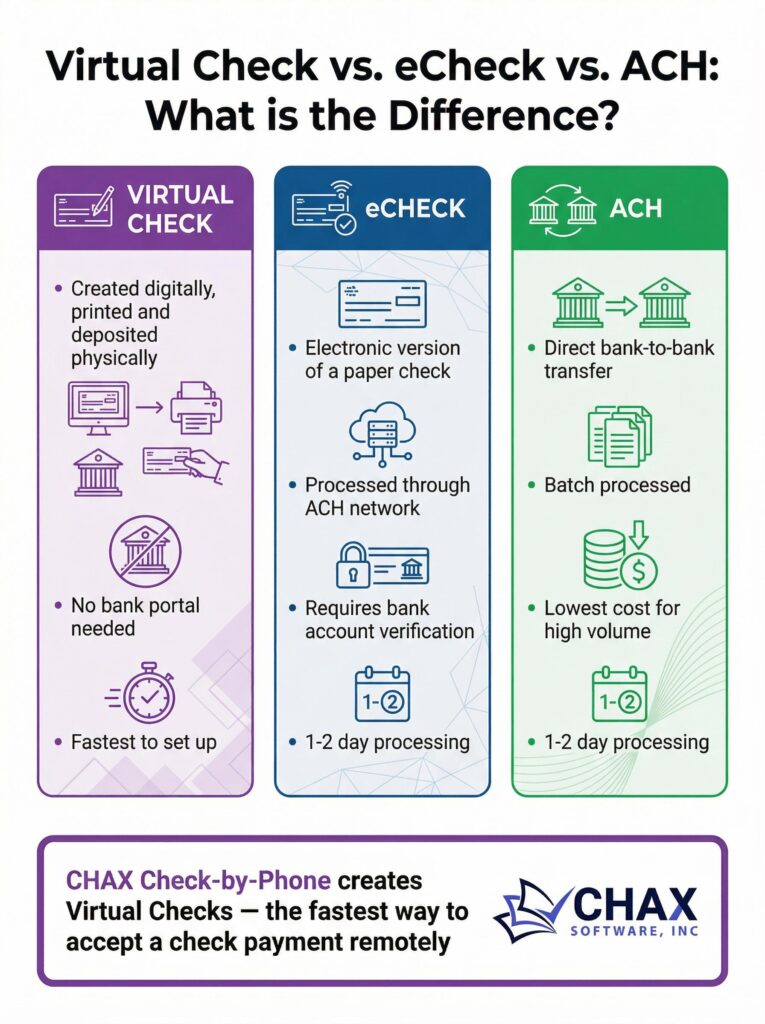
The Difference Between a Virtual Check, an eCheck, and an ACH Payment
In the landscape of digital payments, several terms are often used interchangeably, leading to confusion. “Virtual check,” “eCheck,” and “ACH” all describe methods of paying someone without using a physical paper check or a credit card, but they are not the same thing. Understanding the distinctions is crucial for choosing the right payment method for your business.
This guide clarifies the differences between these three common payment types.
ACH (Automated Clearing House)
What it is: ACH is the underlying electronic network that connects virtually all banks and credit unions in the United States. It is the infrastructure used to execute electronic payments and money transfers directly between bank accounts. When you receive a direct deposit from your employer or pay a utility bill directly from your checking account, you are using the ACH network.
How it works: To initiate an ACH payment, the payer must provide their bank account number and routing number to the payee. The payee then submits a request to the ACH network to “pull” the funds from the payer’s account. The process typically takes 2-3 business days to settle, though same-day ACH is becoming more common.
Key Characteristic: It is a purely electronic, bank-to-bank transfer. No “check” is ever created.
eCheck (Electronic Check)
What it is: The term “eCheck” is often used as a synonym for an ACH payment. In most contexts, when a company says they accept “eChecks,” they mean they will be processing the payment as an ACH transaction. The customer provides their banking information, and the business initiates an ACH debit.
How it works: Functionally, the process is identical to an ACH payment. The term “eCheck” was coined to make the concept of a direct bank debit more familiar and understandable to consumers who were used to writing paper checks.
Key Characteristic: It is essentially a user-friendly marketing term for an ACH payment.
Virtual Check (or Remotely Created Check)
What it is: This is where the most significant difference lies. A virtual check, also known as a Remotely Created Check (RCC), is a fundamentally different instrument. It is a printable check image that is created by the payee with the payer’s authorization.
How it works:
1. The customer provides their banking information over the phone or via a web form.
2. The business uses a specialized software like CHAX to generate a complete, legally valid check image.
3. This check is then printed by the business.
4. The printed document is a negotiable check that is deposited just like any other check—via mobile deposit, desktop scanner, or at the bank.
Key Characteristic: A virtual check results in a physical, paper check that is deposited into the banking system. It is not a direct electronic transfer.
Comparison Table
| Feature | ACH / eCheck | Virtual Check (RCC) |
| :— | :— | :— |
| Process | Purely Electronic Transfer | Digital to Physical to Deposit |
| Result | Funds moved bank-to-bank | A printable, depositable check |
| Speed | 2-3 Business Days | Instant creation, then deposit time |
| Infrastructure | ACH Network | Check Clearing System (Check 21) |
| Best For | Recurring debits, direct deposit | One-time phone payments, immediate payment assurance |
Which Should You Use?
- Choose ACH/eCheck for reliable, recurring payments from trusted customers or for payroll. It is a low-cost and efficient “set it and forget it” method.
- Choose Virtual Checks (RCCs) when you need to secure a payment immediately* over the phone. It is the perfect tool for service businesses, sales teams, and collection agencies who need to get a commitment to pay and a deposit-ready check in hand during a single conversation.
While ACH and eChecks are excellent for automated transfers, the virtual check offers a unique advantage for immediate, one-time payments without the high fees of credit cards, making it an essential tool in a modern business’s payment toolkit.