
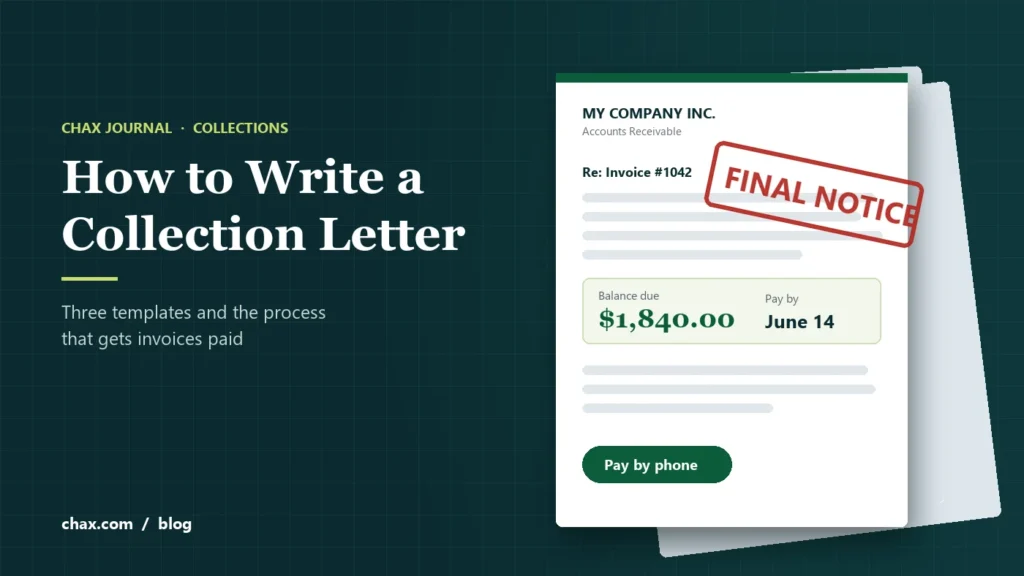
A good debt collection letter is short, factual and easy to act on. Include:
- The customer’s name and account or invoice number
- The amount owed, the original due date and what it was for
- A specific deadline and a clear request (“please pay $1,840 by June 14”)
- Every way they can pay, including by phone
- A contact person, and an offer to talk about a payment plan
Send a series rather than one letter: a friendly reminder, a firmer second notice, then a final notice that says what happens next. If you collect consumer debts for someone else, the federal FDCPA and the CFPB’s Regulation F also apply.
Late payments are a cash problem before they are a legal one. Every invoice that sits unpaid is money you have already earned but can’t spend. The longer it waits, the harder it is to collect. This guide covers the letter itself, with three templates, and the process around it: when to send each letter, what the law requires, and how to make paying easy.
Why collections need a process, not a single letter
Most overdue invoices are not refusals. They are forgotten, stuck in an approval queue, or waiting on a question nobody asked. A predictable sequence of reminders, letters and calls fixes most of them before anyone needs an agency. A process also protects you: when every customer gets the same steps on the same schedule, your records show you were fair and consistent if a dispute ever reaches a court.
The three letters, side by side
| Letter | When | Tone | What it adds |
|---|---|---|---|
| 1. Friendly reminder | About 15 days past due | Helpful; assumes an oversight | Copy of the invoice, ways to pay, a contact name |
| 2. Second notice | About 30 days past due | Direct and businesslike | A firm deadline, an offer of a payment plan, a phone call |
| 3. Final notice | About 45 days past due | Serious, never threatening | The exact next step and date, such as late fees under your terms, an agency or small claims court |
What to include in every debt collection letter
- Your business name, address and phone
- The date of the letter
- Customer name and account number
- Invoice number, date and what it was for
- Amount due, with any payments already made
- The original due date and days past due
- A specific “pay by” date
- Every way to pay: check, phone, ACH, card
- A named contact and direct line
- An offer to discuss a plan or a dispute
Keep the letter to one page. State facts, not feelings. Avoid sarcasm, capital letters and red ink. Proofread the numbers twice: a wrong amount is the fastest way to turn a late payer into a disputing one.
Debt collection letter templates
Copy and adapt these. Replace everything in brackets.
Dear [Name],
Our records show that invoice [#1042], dated [April 2] for [service or goods], is now [15] days past due. The balance is [$1,840.00]. A copy is attached.
If you’ve already sent payment, thank you, and please ignore this letter. If not, you can pay by check, by phone at [your phone], or by bank transfer using the details on the invoice.
If something on the invoice needs correcting, call me at [direct line] and I’ll sort it out.
Thank you,[Your name], [Title]
Dear [Name],
Invoice [#1042] for [$1,840.00] is now [30] days past due, and we haven’t received a reply to our reminder of [date].
Please pay the full balance by [date, 10 days out]. If paying it all at once is difficult, call me at [direct line] before that date and we can agree on a payment schedule in writing.
You can pay by phone today by giving us your check details, or by mailing a check to [address].
Sincerely,[Your name], [Title]
Dear [Name],
This is our final notice about invoice [#1042] for [$1,840.00], now [45] days past due. We have written on [date] and [date] and called on [date].
If we do not receive payment or hear from you by [date], we will [refer the account to a collection agency / file a claim in small claims court / apply the late fee in our terms]. We would prefer to resolve this directly with you.
To pay now, call [your phone] or send a check to [address].
Sincerely,[Your name], [Title]
Only name a next step you are prepared to take. Saying you will sue or refer an account, and then not doing it, damages your credibility. If the debt is a consumer debt, it can also break the law.
Turn your second letter into a payment
CHAX 11 builds the paperwork that goes with your collection letters, so a customer who says yes can pay by check right away:
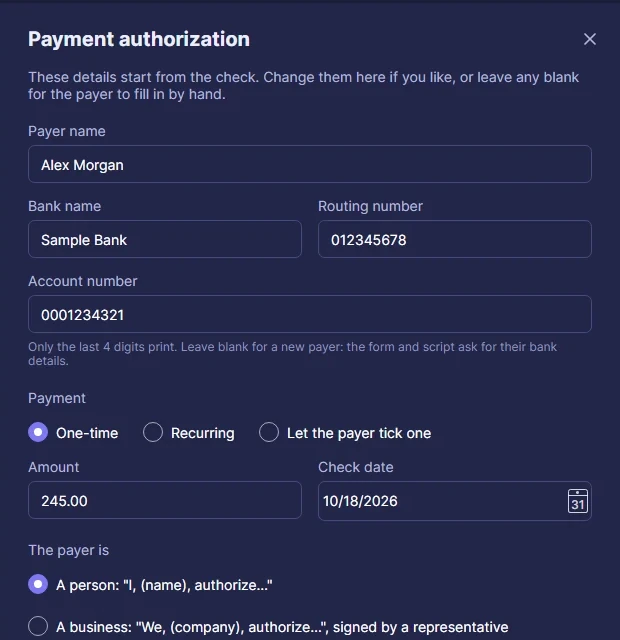
- Payment authorization form to send with your letter. It is worded for a person (“I, … authorize”) or a business (“We, … authorize”), and asks a new customer to write in their bank details or attach a voided check.
- Built-in phone script as a PDF you read word for word on a recorded call, ticking a box after each “yes”.
- Check drafts on blank stock with the customer’s MICR line, ready to deposit at your bank, with no CHAX transaction fees.
- A record of every check in the transaction history and audit log, in case a payment is ever questioned.
From $15 a month or $299 for a lifetime license. Compare editions.
The law: what applies to your letters
Which rules apply depends on who is collecting and what kind of debt it is.
| Situation | Main rules |
|---|---|
| A collection agency or law firm collecting consumer debt for someone else | The Fair Debt Collection Practices Act (FDCPA) and the CFPB’s Regulation F, including the validation notice. The CFPB publishes a model form. |
| A business collecting its own consumer invoices, in its own name | Generally outside the FDCPA, but the FTC Act still bars deceptive or unfair practices. Some states, such as California under the Rosenthal Act, cover original creditors too. |
| A business collecting its own business-to-business invoices | The FDCPA covers only debts for personal, family or household purposes. Contract law, your payment terms and state law apply. |
| A business that collects using a different name | Can be treated as a debt collector under the FDCPA. Always collect in your real business name. |
Never do this, whoever you collect from
- Threaten arrest, violence, or action you can’t or won’t take
- Misstate the amount, or add fees your contract doesn’t allow
- Pretend to be a lawyer, an agency or a government office
- Tell the debtor’s employer, family or neighbors about the debt
- Call repeatedly to harass, or at unreasonable hours
This is general information, not legal advice. If you collect consumer debts or operate in several states, have an attorney review your letters.
Best practices that get invoices paid
- Prevent first. Clear payment terms, a signed agreement and an accurate invoice sent on time prevent most late payments.
- Contact early. A reminder three days after the due date gets more response than a letter at 60 days.
- Use more than one channel. Email, a mailed letter and a phone call reach different people in an accounts payable department.
- Be consistent. Treat every customer the same way on the same schedule.
- Document everything. Log every call, letter and promise to pay with the date and the name of the person.
- Offer a plan. A written payment plan the customer keeps beats a balance you write off.
- Make paying easy. Every extra step between “yes” and money in the bank costs you collections.
Common collection challenges and how to handle them
| Challenge | What usually works |
|---|---|
| No response at all | Change channels: call, then send a letter to the billing address. Ask for the person who approves payments. |
| “The check is in the mail” | Ask for the check number and date, and offer to take payment by phone now instead. |
| A dispute over the invoice | Pause and resolve it in writing. Collect the undisputed part separately. |
| Customer can’t pay in full | Agree on a written plan with dates, and send a reminder before each installment. |
| A good customer, paying late | Call rather than write. Then review terms, deposits or credit limits for future orders. |
| Staff dread making calls | Give them a script, authority to set plans within limits, and the account history before the call. |
Take payment by phone the moment they say yes
The weakest moment in collections is between “I’ll send a check” and the check arriving. Taking the check payment during the call closes that gap. With CHAX check-by-phone software, the process looks like this:
- The customer agrees to pay and reads the routing number, account number and check number from one of their checks.
- You get their authorization, recorded on the call or in writing, for that amount and date.
- CHAX prints the check with the customer’s MICR line, ready to deposit at your bank the same day.
- You send a confirmation with the amount, date and check number.
No processing fee applies per payment, and the funds move through normal check clearing. Read the check-by-phone guide for the authorization rules and how these checks clear.
How much cash is tied up in late invoices?
Days sales outstanding (DSO) is the average number of days it takes customers to pay you. Cutting it by even a week frees cash you can use, without a loan.
The math is simple: receivables = annual credit sales ÷ 365 × days to get paid. For every $1 million in yearly credit sales, each day of DSO holds about $2,740. Here is what cutting DSO frees, and what that cash would cost to borrow at 8% a year:
| Cut in days to get paid | Cash freed per $1M of credit sales | Yearly financing cost saved at 8% |
|---|---|---|
| 5 days | $13,699 | $1,096 |
| 10 days | $27,397 | $2,192 |
| 15 days | $41,096 | $3,288 |
| 20 days | $54,795 | $4,384 |
Worked example: a business with $1.2 million in credit sales that gets paid in 55 days has about $180,800 tied up in receivables. Getting paid in 40 days frees about $49,300, worth roughly $3,900 a year in interest at 8%.
Frequently asked questions
How do I write a polite debt collection letter?
Assume an oversight. State the invoice, amount and due date, attach a copy, list the ways to pay, and give a contact name. Save the firm tone for the second notice.
How many collection letters should I send?
Three is typical: a reminder, a second notice and a final notice, about two weeks apart, with a phone call before the final notice.
Can I add interest or late fees?
Only if your contract or invoice terms allow it and your state’s law permits the amount. Don’t add a fee in a letter that the customer never agreed to.
Does the FDCPA apply to my business?
Usually not if you collect your own invoices in your own name, and never for business-to-business debts. It does apply to third-party collectors of consumer debts. State laws can be broader, so check yours.
Should I send letters by certified mail?
For a final notice, certified mail with a return receipt gives you proof of delivery if the account goes to an agency or court.
Sources
- Fair Debt Collection Practices Act, Federal Trade Commission
- Regulation F (Debt Collection Practices), 12 CFR Part 1006, Consumer Financial Protection Bureau
- Regulation F Appendix B, Model Form B-1 validation notice, Consumer Financial Protection Bureau
- Think your company’s not covered by the FDCPA? You may want to think again, FTC Business Blog
- Rosenthal Fair Debt Collection Practices Act, California Civil Code § 1788, California Legislative Information
- How to Accept Checks by Phone: Rules, Check 21 and ACH, CHAX
