Are Checks by Phone Legal? A Guide to FTC and NACHA Rules
When businesses first hear about CHAX Check-by-Phone, one of the most common questions is a simple but important one: “Is this actually legal?” It’s a fair question. Creating a check on behalf of someone else, without their physical signature, sounds like it could be in a legal grey area.
The answer is clear: yes, checks by phone are completely legal in the United States. They are a well-established and recognized payment instrument. However, as with any financial transaction, there are specific rules you must follow to ensure you are operating in compliance. Understanding these rules is not just a legal obligation — it is also the foundation of ethical business practice and customer trust.
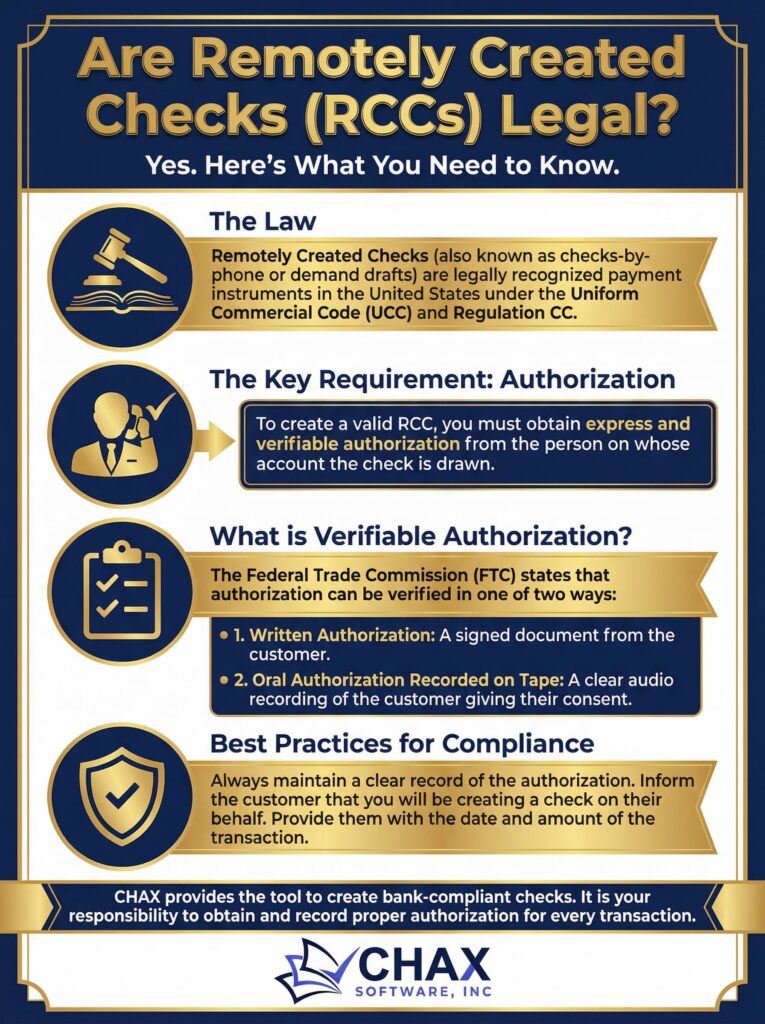
!Are Remotely Created Checks (RCCs) Legal?

The Legal Foundation: What the Law Says
Remotely Created Checks (RCCs) — the formal name for checks-by-phone — are legally recognized payment instruments under two key pieces of U.S. law:
- The Uniform Commercial Code (UCC): The UCC is a set of laws governing commercial transactions in the United States. Article 3 of the UCC governs negotiable instruments, including checks. RCCs are treated as negotiable instruments under the UCC, meaning they carry the same legal weight as a traditionally signed check.
- Regulation CC (Availability of Funds and Collection of Checks): This Federal Reserve regulation governs how banks process checks. It explicitly includes RCCs within its definition of a check, confirming that banks are required to process them through the standard check clearing system.
The Key Requirement: Verifiable Authorization
While RCCs are legal, the law places a critical responsibility on the business creating them: you must obtain express and verifiable authorization from the account holder before creating a check on their behalf.
This is the cornerstone of legal compliance. The Federal Trade Commission (FTC) has issued specific guidance on this requirement. According to the FTC, authorization for a telephone-initiated payment must be verifiable in one of two ways:
| Method | Description |
| :— | :— |
| Written Authorization | A signed document from the customer authorizing the specific payment or series of payments. This could be a signed contract, a service agreement, or a dedicated authorization form. |
| Oral Authorization Recorded on Tape | A clear audio recording of the customer giving their verbal consent to the payment. The recording must capture the customer’s agreement to the specific amount and the authorization to create a check on their account. |
For most businesses using CHAX for phone-based collections, the recorded oral authorization is the most practical method. It requires that you inform the customer the call is being recorded and that they verbally agree to the transaction.
Best Practices for Compliance
Following a consistent, documented process for every transaction is the best way to ensure you remain compliant and protect your business from disputes.
- Always record your authorization calls. This is your primary evidence that the customer consented to the payment.
- Clearly state the amount and date. The customer must know exactly what they are authorizing.
- Maintain your records. Keep records of all authorizations for a minimum of two years.
- Provide a clear description on the check. The check should identify your business so the customer can recognize it on their bank statement.
CHAX provides the technology to create bank-compliant checks. Your responsibility as a business owner is to ensure that you obtain and properly document authorization for every single transaction. By doing so, you can use CHAX with complete confidence, knowing your payment collection process is both effective and fully legal.
This article is for informational purposes only and does not constitute legal advice. Consult with a qualified attorney for guidance specific to your business situation.