
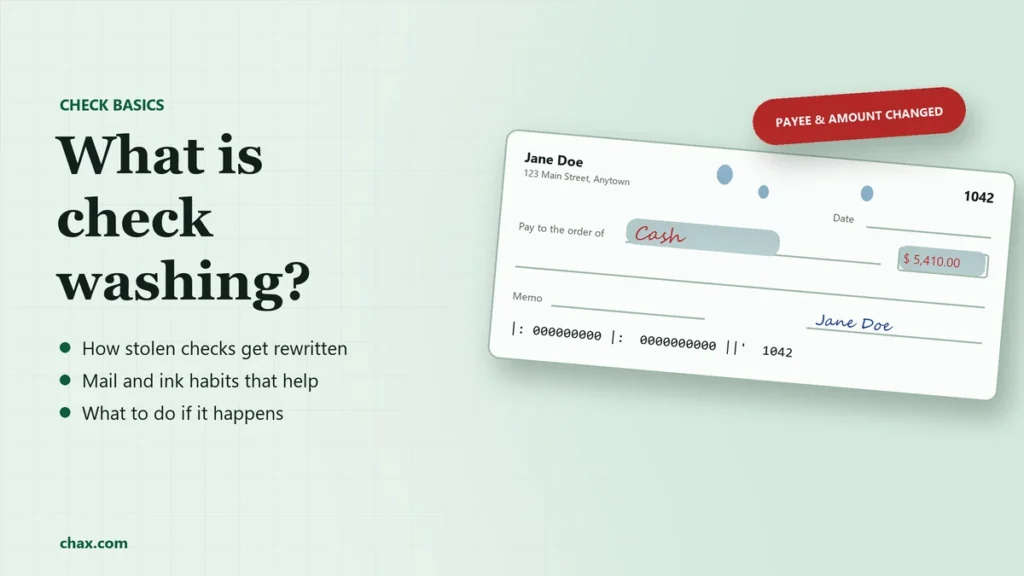
Check washing is a scam where criminals steal checks, usually from mailboxes, remove the ink with chemicals, and rewrite the payee name and often the amount before depositing them. Some skip the chemicals and use the stolen check as a template to print counterfeits.[1]
The best protection is keeping checks out of thieves’ hands: mail them inside the post office or in a blue collection box before the last pickup, collect your mail promptly, and review your account often so you can report problems fast.[1]
How check washing works
- A check is stolen, often from a home mailbox with the flag up, or from a collection box.
- The ink is removed. Thieves use chemicals to dissolve the payee name and amount while leaving the signature, the printed details and the MICR line intact.
- The check is rewritten with a new payee, sometimes “Cash” or a fake business, and a larger amount.
- It’s deposited, often by mobile deposit or into an account opened for the purpose, before the account holder notices.
A variation skips the washing. The stolen check is copied or scanned, and its account details are used to print counterfeit checks.[1]
How common is it?
Check fraud tied to mail theft has surged. FinCEN, the U.S. Treasury’s financial crimes bureau, reports that banks filed more than 680,000 suspicious activity reports for possible check fraud in 2022, nearly double the year before.[2] In a review of mail theft-related reports, 44 percent of stolen checks were altered and deposited, 26 percent were used as templates for counterfeits, and 20 percent were signed and deposited fraudulently.[3] The U.S. Postal Inspection Service says its inspectors recover more than $1 billion in counterfeit checks and money orders each year.[1]
How to protect your checks
Mailing
- Mail checks inside the post office, or in a blue collection box before the last pickup of the day.[1]
- Don’t leave outgoing checks in your home mailbox with the flag up.
- Collect incoming mail promptly, and don’t leave it in the mailbox overnight.[1]
- Hold your mail when you travel, or have someone you trust pick it up.[1]
Writing the check
- Use a pen with permanent ink rather than an erasable pen or pencil. Pigment-based gel ink is generally harder to remove than ordinary ballpoint ink.
- Fill in every line, start the amount at the far left, and draw a line through the empty space. See how to write a check.
- Never sign a blank check.
Watching your account
- Review activity often, in your app or online banking, and reconcile monthly with a check register.
- Look at check images your bank provides for any cleared check that looks unfamiliar, including the payee and endorsement.
- Pay electronically when that’s practical, so fewer paper checks travel through the mail.
What to do if your check was washed
- Call your bank right away. Report the altered check, ask what forms it needs, and ask whether to stop payment on other outstanding checks or close the account.
- Report the mail theft to the U.S. Postal Inspection Service at uspis.gov.[1]
- File a police report if your bank asks for one.
- Tell the intended payee and pay them another way once your bank confirms what happened.
- Keep records of every call, form and reference number.
Don’t wait. Under the Uniform Commercial Code, you’re expected to review your statements with reasonable promptness and report unauthorized payments promptly. Claims about an altered check are generally barred if you don’t report within one year after the statement was made available.[4]
For businesses
Business checks are prime targets because they’re often large and go to predictable payees. Beyond the habits above:
- Ask your bank about Positive Pay, especially payee Positive Pay, which flags any check whose payee or amount doesn’t match the checks you issued.
- Use security check stock with features that make chemical alteration visible, and keep blank stock locked up.
- Limit who can print and sign checks, and reconcile every account monthly.
If you print checks on blank stock with MultiCHAX, each payee and amount is printed in toner rather than handwritten, and you can search the history of every check printed to compare with your bank’s records. Our check fraud guide covers more safeguards.
Frequently asked questions
Can a washed check be detected?
Sometimes. Security features on check stock can show stains or patterns when chemicals are used, and banks look for signs of alteration. Many washed checks still get through, which is why prevention and quick reporting matter.
Am I responsible if someone washes my check?
Generally, if you report promptly, an altered check isn’t your loss to bear. The details depend on your bank agreement and how quickly you report. Contact your bank as soon as you notice.
Does gel ink prevent check washing?
It helps. Pigment-based gel ink soaks into the paper and is generally harder to remove than ordinary ink, but nothing replaces keeping checks out of thieves’ hands.
Is it safe to mail checks?
It’s safer when you mail them inside the post office or in a blue collection box before the last pickup, and when you watch your account for the check to clear.
Sources
- Check Washing, U.S. Postal Inspection Service
- FinCEN Alert on Nationwide Surge in Mail Theft-Related Check Fraud Schemes (FIN-2023-Alert003), Feb. 27, 2023
- FinCEN Issues In-Depth Analysis of Check Fraud Related to Mail Theft, Sept. 2024
- Uniform Commercial Code § 4-406, customer’s duty to discover and report unauthorized signature or alteration, Cornell Law School LII
Last reviewed November 2026. This article is general information, not legal or financial advice.
