
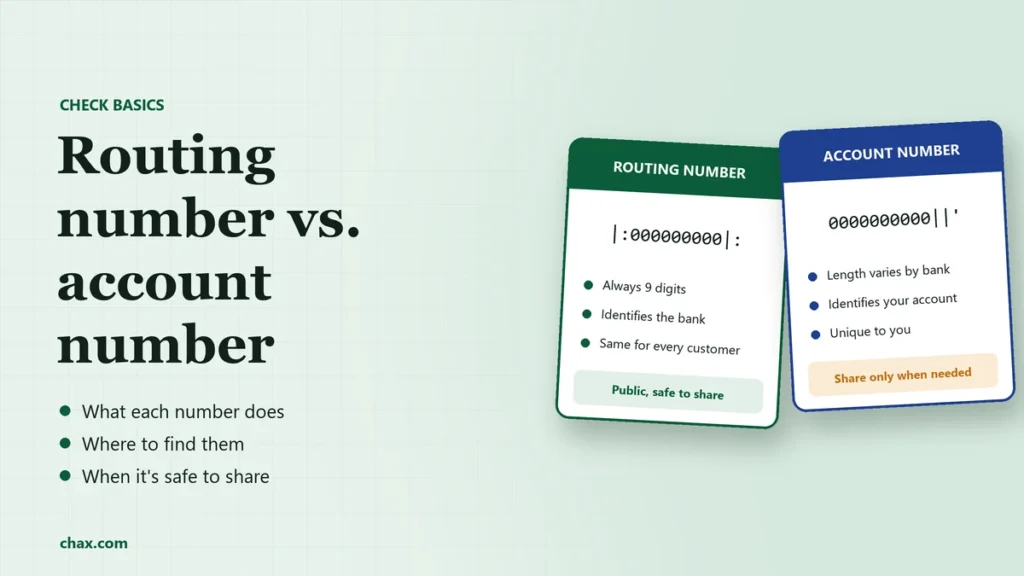
A routing number identifies your bank. It’s always 9 digits, and everyone with an account at that bank (in that region) shares it. An account number identifies your account at that bank. Its length varies, and it’s unique to you.
You need both to set up direct deposit, automatic payments or a transfer. On a check, the routing number is the first group of numbers at the bottom, and the account number comes next.[1][2]
Routing number vs. account number at a glance
| Routing number | Account number | |
|---|---|---|
| What it identifies | The bank or credit union | Your specific account |
| Length | Always 9 digits[1] | Varies by bank |
| Who has the same one | Other customers of the same bank | No one else |
| Who issues it | The ABA’s official registrar[2] | Your bank |
| Where on a check | Bottom left, between two ⑆ symbols | After the routing number, usually ending with ⑈ |
| Is it public? | Yes. It’s published and printed on every check | Keep it private and share only when needed |
What a routing number does
A routing number, also called an ABA routing number or routing transit number, tells the payment system which bank to send money to or collect it from. The first four digits form the Federal Reserve routing symbol, the first two of which show the bank’s Federal Reserve District. The last digit is a check digit that helps catch typos.[1]
Large banks often have several routing numbers, for example one per state or region, and some list a different number for wire transfers. You can check which bank a routing number belongs to with our free bank routing number lookup.
What an account number does
Once a payment reaches your bank, the account number tells the bank which account to credit or debit. Account numbers aren’t standardized like routing numbers. Each bank sets its own format, so yours may be shorter or longer than someone else’s. Your debit card number is a different number and can’t be used in place of your account number.
Where to find both numbers
- On a check: along the bottom. On most personal checks, the order is routing number, account number, check number. Many business checks put the check number first. Our guide to how to read a check has a labeled diagram.
- In your bank’s app or online banking: usually under account details. Many apps also offer a pre-filled direct deposit form.
- On your bank statement: the account number appears on every statement, sometimes partly masked.
- From the bank: call or visit a branch, especially if you need the routing number for wires.
Which numbers do you need?
| Task | What to give |
|---|---|
| Direct deposit from an employer | Routing number, account number and account type. Some employers ask for a voided check instead. |
| Automatic bill payments | Routing and account numbers |
| Receiving a domestic wire | The routing number your bank lists for wires, plus your account number |
| Receiving an international wire | Usually a SWIFT code from your bank, plus your account number. Ask your bank for its instructions. |
| Ordering checks | Both, printed in the MICR line at the bottom |
Use the number your bank gives for the job. The routing number on your checks isn’t always the one for wires or electronic payments. If your bank lists separate numbers, use the one it names for that purpose.
Is it safe to share your routing and account numbers?
Your routing number is public. It identifies your bank, not you. Your account number is more sensitive, because together the two numbers are enough to set up some electronic debits. They also appear on every check you write, so share them with employers, billers and people you trust, and never in reply to an unexpected call, text or email.
Check your statements every month. If you see an electronic debit you didn’t authorize, report it to your bank promptly. Federal Regulation E sets deadlines that limit what you can lose, and the key one is reporting within 60 days after the statement showing the transfer was sent.[3][4] Our check register guide shows how to reconcile.
For businesses that print checks
When you print checks on blank stock with MultiCHAX, you enter each bank account’s routing and account numbers once, and the software prints them in the MICR line at the bottom of every check. A single wrong digit means checks can be rejected or misrouted, so copy both numbers from a statement or check your bank issued, confirm the routing number with the lookup tool, and test one printed check with your bank before sending any.
Frequently asked questions
Is the routing number the same as the account number?
No. The routing number identifies the bank and is shared by many customers. The account number identifies your account and is unique to you.
Can two people have the same routing number?
Yes. Customers of the same bank, and often the same state or region, share a routing number. Their account numbers are different.
Is the account number on a check the first or second set of numbers?
On most personal checks it’s the second set, after the 9-digit routing number. On many business checks the check number comes first.
How many digits is an account number?
It depends on the bank. Unlike routing numbers, which are always 9 digits, account numbers don’t have a single standard length.
Can someone take money with my routing and account numbers?
Someone could try to set up an unauthorized electronic debit or forge a check. That’s why you should share both numbers only when needed, review statements monthly, and report anything you don’t recognize to your bank right away.
Sources
- 12 CFR Part 229, Appendix A, routing number guide, Cornell Law School LII
- ABA Routing Number, American Bankers Association
- 12 CFR 1005.6, liability for unauthorized transfers (Regulation E), Cornell Law School LII
- 12 CFR 1005.11, procedures for resolving errors (Regulation E), Cornell Law School LII
Last reviewed November 2026. This article is general information, not legal or financial advice. Confirm account details with your bank.
