
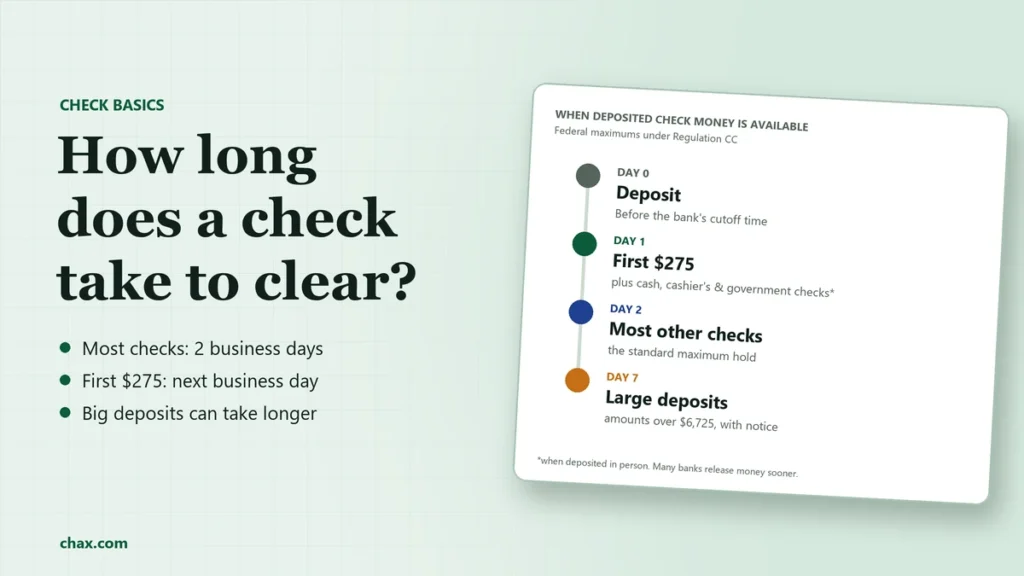
Under federal Regulation CC, most checks you deposit must be available to withdraw by the second business day after the day you deposit them. The first $275 of a day’s check deposits must be available the next business day, and so must cashier’s, certified and government checks deposited in person.[1][2]
Banks can hold some deposits longer, such as deposits over $6,725 in a day or deposits to accounts less than 30 days old, but they must tell you.[3] These are maximums. Many banks release money sooner.
Federal check hold times at a glance
Day 1 means the first business day after the banking day of your deposit. Business days are generally Monday through Friday, except federal holidays.[5]
| What you deposit | Latest the money must be available |
|---|---|
| Cash, in person with a teller | Next business day[1] |
| Electronic payments, such as direct deposit | Next business day after the bank receives them[1] |
| Cashier’s, certified and teller’s checks, in person into the payee’s account | Next business day[1] |
| U.S. Treasury checks into the payee’s account | Next business day[1] |
| USPS money orders, and state or local government checks, in person | Next business day[1] |
| Checks drawn on your own bank (same state) | Next business day[1] |
| First $275 of all other checks deposited that day | Next business day[1] |
| The rest of most other checks | Second business day[2] |
| Checks or cash at an ATM your bank doesn’t own | Fifth business day[2] |
| Deposits covered by an exception (large, new account and others) | Longer, usually up to 5 extra business days, with notice[3] |
The rule also has a longer limit for “nonlocal” checks, but the Federal Reserve has had a single national check processing region since 2010, so in practice no checks are nonlocal anymore.[7]
Why the deposit time matters
The clock starts on the banking day you deposit the check. Banks can set a daily cutoff time, no earlier than 2 p.m. at branches and no earlier than noon at ATMs. A deposit made after the cutoff, or on a weekend or holiday, can be treated as made on the next banking day.[4]
So a check deposited Friday evening is treated as deposited Monday, and the “second business day” becomes Wednesday.
How long does it take for a $30,000 check to clear?
Large checks can be held longer under the large-deposit exception, which applies to the part of a day’s check deposits over $6,725.[3] Here’s the federal maximum for a $30,000 personal check from another bank, deposited with a teller on a Monday before the cutoff, into an account open more than 30 days:
| Day | Amount available | Why |
|---|---|---|
| Tuesday (day 1) | $275 | The first $275 of check deposits[1] |
| Wednesday (day 2) | $6,450 more ($6,725 total) | Standard schedule for amounts up to $6,725[2][3] |
| Next Wednesday (day 7) | The remaining $23,275 | Large-deposit exception: up to 5 more business days, with written notice[3] |
A holiday pushes each date back a day. A bank can sometimes justify an even longer hold, but it has to show the extra time is reasonable.[3] If you need the full amount quickly, ask the payer for a cashier’s check or a wire. A cashier’s or certified check deposited in person qualifies for next-day availability, though the large-deposit exception can still apply to the amount over $6,725.
When a bank can hold a check longer
Regulation CC lets banks extend holds in specific situations:[3]
- Large deposits: the amount of a day’s check deposits over $6,725.
- New accounts: accounts open less than 30 days.
- Redeposited checks: a check that was returned unpaid and deposited again.
- Repeated overdrafts: accounts overdrawn often in the last six months.
- Reasonable cause to doubt the check: the bank has specific facts suggesting the check won’t be paid.
- Emergencies: such as equipment failures or a natural disaster.
When a bank uses an exception, it generally has to give you a written notice with the amount held, the reason and when the money will be available, usually at the time of deposit.[3] For most exceptions, a reasonable extension is up to five more business days for ordinary checks.[3]
What about mobile deposits?
Banks generally treat mobile deposits like other deposits that aren’t made in person with a teller, and many set an earlier cutoff time for the app. Your bank’s funds availability policy, which comes with your account agreement, lists its exact timing. Endorse the check the way your bank asks before you take the photo. See how to endorse a check.
Available isn’t the same as cleared
When money becomes “available,” you can withdraw it, but the check may not have been paid yet. If it bounces later, or turns out to be fake, the bank can take the money back out of your account, even after you’ve spent it.[6]
Be careful with checks from strangers. Fake check scams depend on this gap. If someone sends you a check for more than you’re owed and asks you to send back the difference, don’t. Wait until your bank confirms the check has actually been paid.[6]
How to get your money faster
- Deposit in person with a teller, before the cutoff time, on a business day.
- Ask for a cashier’s or certified check for large or time-sensitive payments.
- Ask your bank about its own policy. Many banks release more than the federal minimum, especially for long-standing customers.
- Check the date first. A check that’s too old may be refused. See how long a check is good for.
- Use direct deposit or electronic payments when you can. They’re available the next business day after the bank receives them.[1]
For businesses that get paid by check
Hold times shape cash flow. A check that arrives in Friday’s mail and goes to the bank Monday may not be fully available until Wednesday, and a large customer payment can take a week or more.
Businesses that take payments remotely with CHAX check by phone software skip the mail wait. The customer authorizes the payment, the business prints a check draft and deposits it the same day. The draft follows the same Regulation CC availability rules as any other check, so the clock starts sooner.
Whichever way checks arrive, record each deposit in your check register and don’t count the money as spendable until it’s available.
Frequently asked questions
How long does it take for a check to clear?
For most checks, the money must be available by the second business day after the deposit, with the first $275 available the next business day. Final payment of the check can take longer than availability.
Why is my check on hold?
Usually because of one of the exceptions: a large deposit, a new account, a redeposited check, repeated overdrafts or a reason to doubt the check. Your bank’s hold notice should say which.
Do weekends count?
No. Weekends and federal holidays aren’t business days, and a deposit made on one is treated as made on the next banking day.
How long does a cashier’s check take to clear?
Next business day when deposited in person with a teller into the payee’s account, or by the second business day otherwise. See our guide to cashier’s checks.
Can I see where the check is drawn?
Yes. The routing number at the bottom identifies the paying bank. Our guide to how to read a check shows where it is, and our routing number lookup names the bank.
Sources
- 12 CFR 229.10, next-day availability (Regulation CC), Cornell Law School LII
- 12 CFR 229.12, availability schedule (Regulation CC), Cornell Law School LII
- 12 CFR 229.13, exceptions (Regulation CC), Cornell Law School LII
- 12 CFR 229.19, cutoff hours and miscellaneous provisions (Regulation CC), Cornell Law School LII
- 12 CFR 229.2, definitions of banking day and business day (Regulation CC), Cornell Law School LII
- How to Spot, Avoid, and Report Fake Check Scams, Federal Trade Commission
- Federal Reserve Board, Regulation CC interim final rule, Mar. 25, 2011 (single national check processing region)
Last reviewed November 2026. Dollar amounts are those in effect since July 1, 2025. This article is general information, not legal or financial advice. Your bank’s funds availability policy has its exact timing.
