
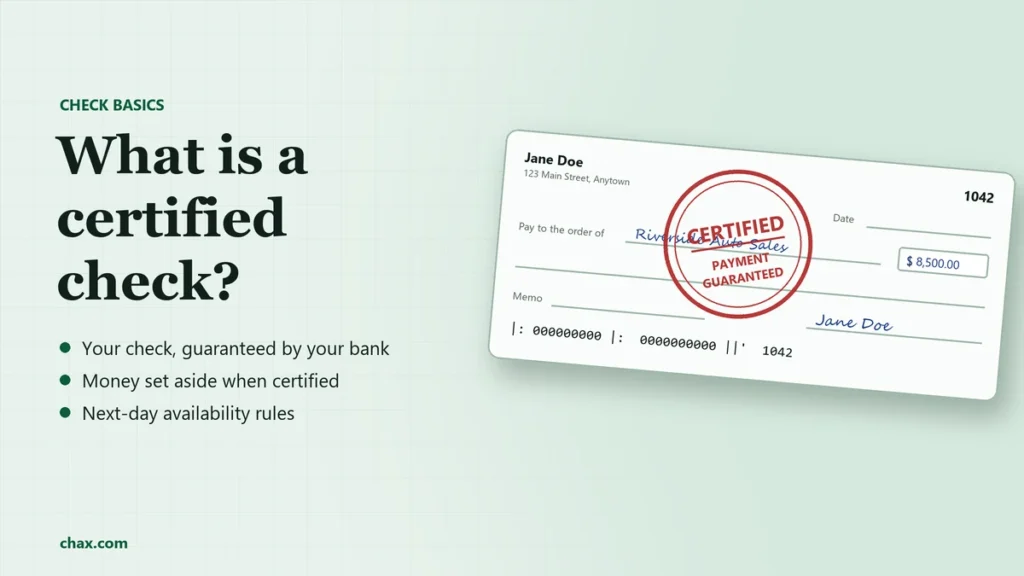
A certified check is your own personal check that your bank has accepted and guaranteed. The bank confirms you have the money, sets that amount aside, and marks the check as certified, usually with a stamp and an employee’s signature. The person you pay no longer depends on your balance, because the bank has promised to pay.[1]
Fewer banks offer certified checks today, and many offer a cashier’s check instead. When the payee deposits a certified check in person with a teller, the money is generally available the next business day.[2]
How a certified check works
Under the Uniform Commercial Code, a certified check is “a check accepted by the bank on which it is drawn.”[1] Accepting a check means the bank signs an agreement to pay it. After that, paying the check is the bank’s obligation, not just a hope that your account has the money.
- You write a check from your own checkbook, filled in with the payee and amount. Don’t sign it until the bank tells you to, as some want to see you sign.
- The bank verifies the money is in your account.
- The bank sets the amount aside, usually by holding or deducting it from your account right away.
- The bank certifies the check, typically with a “certified” stamp, the date and an authorized signature.
- You give the check to the payee, who deposits it like any other check.
A bank doesn’t have to certify a check, and refusing isn’t treated as dishonoring it.[1] That’s one reason certified checks have become harder to get.
How to get a certified check
- Call your bank first and ask whether it certifies checks. If it doesn’t, ask about a cashier’s check instead.
- Go to a branch with your checkbook and a photo ID. Certification is usually done in person.
- Know the exact payee name and amount. The check is certified as written, so mistakes mean starting over.
- Expect a fee. Amounts vary by bank, and some accounts include certified or cashier’s checks free.
- Keep a record of the check number, amount and date in your check register.
Certified check vs. cashier’s check
Both are guaranteed by a bank and get the same fast availability, but they are drawn differently.
| Certified check | Cashier’s check | |
|---|---|---|
| Whose check it is | Your personal check | The bank’s own check |
| Whose money | Yours, set aside by the bank | The bank’s, after you pay it |
| Who signs | You sign, and the bank certifies | A bank employee |
| Availability for the payee | Next business day when deposited in person with a teller[2] | Next business day when deposited in person with a teller[2] |
| How easy to get | Fewer banks offer them | Offered by most banks |
For fees, uses and how to spot a fake, see our guide to what a cashier’s check is.
What does “certified funds” mean?
When a landlord, title company or car dealer asks for “certified funds,” they want a payment a bank has guaranteed, not a personal check. Depending on who’s asking, that can mean a certified check, a cashier’s check or a wire transfer. Ask exactly which forms they accept before you go to the bank.
How fast is a certified check available?
Federal Regulation CC gives certified, cashier’s and teller’s checks next-business-day availability when they are deposited in person with a bank employee, into an account held by the payee, using a special deposit slip if the bank requires one. Deposited another way, such as at an ATM or by mobile deposit, the money is generally available by the second business day.[2] Banks can hold some deposits longer, for example very large deposits or deposits to new accounts.[3]
For sellers, there’s another benefit. If you take a certified check as payment, the buyer’s debt is generally treated as paid, as if they had paid cash, unless you both agreed otherwise.[5]
Can you stop payment on a certified check?
Generally, no. Under the UCC, a stop-payment order comes too late once the bank has certified the check.[4] The bank has already promised the payee it will pay. A bank that wrongfully refuses to pay a certified check can owe the holder its expenses and lost interest.[8]
If a certified check is lost or stolen
The drawer or the payee can file a declaration of loss with the bank. The claim generally can’t be paid until 90 days after the date the bank certified the check, and if the original check is cashed before then, the bank pays that instead.[6] Contact the bank as soon as you notice the check is missing.
Do certified checks expire?
The UCC’s six-month rule, which lets a bank refuse an old personal check, specifically excludes certified checks.[7] Uncashed funds can eventually be turned over to the state as unclaimed property, though, so deposit one promptly. See how long a check is good for for other types of checks.
Watch out for fake certified checks
Scammers forge certified and cashier’s checks, often in overpayment scams where you’re asked to send back the “extra.” A fake can look real and even be credited to your account before it bounces, and then you owe the money back.[9]
- Look up the issuing bank’s phone number yourself and call to confirm the check. Don’t use the number printed on it.
- Check that the bank name on the check matches the routing number, using our routing number lookup. Our guide to how to read a check shows where it is.
- Be suspicious of any check for more than you’re owed.
Certified checks and businesses
Certification is something only a bank can do, on a check drawn on that bank. If you print your business checks on blank stock with MultiCHAX and a payee asks for certified funds, ask your bank whether it will certify one of your printed checks, or get a cashier’s check or send a wire instead. For everyday payments, printed business checks don’t need certification.
When you receive a certified check, endorse and deposit it as usual. See how to endorse a check.
Frequently asked questions
Is a certified check the same as a cashier’s check?
No. A certified check is your own check, guaranteed by your bank. A cashier’s check is the bank’s own check, drawn on its funds and signed by a bank employee.
Can a certified check bounce?
A genuine certified check is guaranteed by the bank, so it shouldn’t. Fake ones do bounce, sometimes after the money appears in your account.
Can I get a certified check online?
Usually not. Certification generally means taking the physical check to a branch. Some banks let you order a cashier’s check online instead.
Do I sign a certified check?
Yes. It’s your check, so you sign it as the drawer. Some banks want you to sign in front of the teller.
Why won’t my bank certify a check?
Banks aren’t required to certify checks, and many have stopped offering the service. A cashier’s check is the usual alternative.
Sources
- Uniform Commercial Code § 3-409, acceptance of draft and certified check, Cornell Law School LII
- 12 CFR 229.10, next-day availability (Regulation CC), Cornell Law School LII
- 12 CFR 229.13, exceptions that allow longer holds (Regulation CC), Cornell Law School LII
- Uniform Commercial Code § 4-303, when a stop-payment order comes too late, Cornell Law School LII
- Uniform Commercial Code § 3-310, effect of taking a certified, cashier’s or teller’s check, Cornell Law School LII
- Uniform Commercial Code § 3-312, lost, destroyed or stolen cashier’s, teller’s or certified check, Cornell Law School LII
- Uniform Commercial Code § 4-404, checks more than six months old, Cornell Law School LII
- Uniform Commercial Code § 3-411, refusal to pay cashier’s, teller’s and certified checks, Cornell Law School LII
- How to Spot, Avoid, and Report Fake Check Scams, Federal Trade Commission
Last reviewed November 2026. This article is general information, not legal or financial advice. Bank services and fees vary.
