
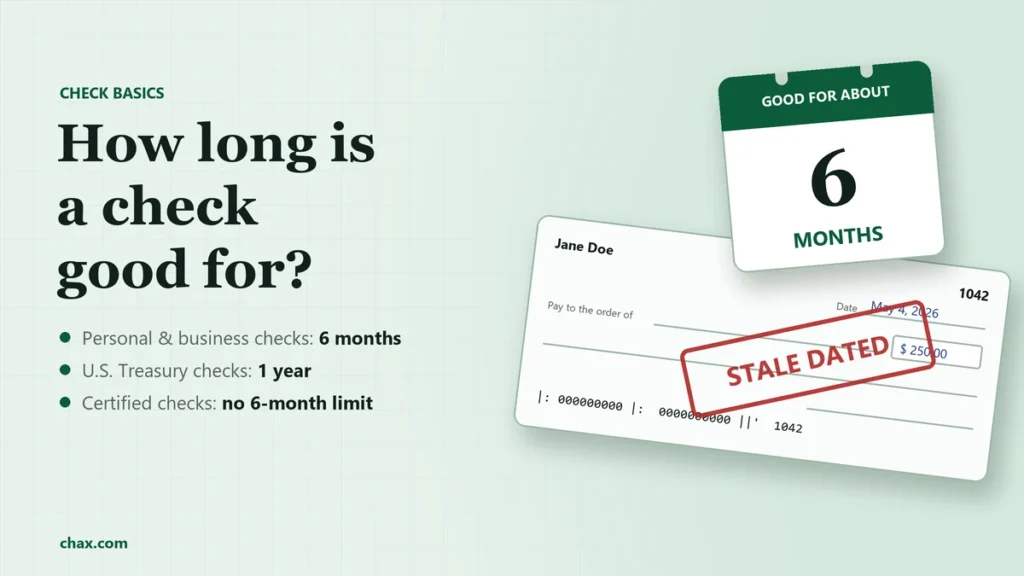
Most personal and business checks are good for six months from the date written on them. After that the check is “stale-dated,” and the bank no longer has to pay it. It still may, though, so an old check isn’t automatically worthless.[1]
U.S. Treasury checks, such as tax refunds and Social Security payments, must be cashed or deposited within one year.[4] Certified checks aren’t covered by the six-month rule.[1] If a check says “Void after 90 days,” treat that date as the deadline.
How long each type of check is good for
| Type of check | Good for | Details |
|---|---|---|
| Personal check | 6 months | After six months the bank may refuse it or pay it, at its discretion.[1] |
| Business and payroll checks | 6 months | The same rule as personal checks. Many businesses print a shorter limit on their checks, such as 90 days. |
| Checks printed “Void after 90 days” (or similar) | Deposit before the printed date | The payer expects you to deposit it by then. The printed limit doesn’t bind the bank, which may still pay or refuse the check afterward, so ask for a new one if you miss it. |
| U.S. Treasury check | 1 year | Treasury doesn’t have to pay a check that isn’t negotiated within 12 months of its issue date. The money may still be owed, but you’ll need to contact the agency that sent it.[4] |
| Certified check | No six-month limit | The six-month rule specifically excludes certified checks.[1] |
| Cashier’s check | No six-month rule, but don’t wait | It’s drawn on the bank’s own funds, so the six-month rule for customers’ checks doesn’t apply. Uncashed funds eventually go to the state as unclaimed property, so deposit it promptly. See what is a cashier’s check. |
A note on wording: the Uniform Commercial Code says “six months,” not 180 days. A check dated March 15 becomes stale after September 15.
What is a stale-dated check?
A stale-dated check is one presented to the bank more than six months after its date. Under the Uniform Commercial Code, which governs checks in every state, a bank “is under no obligation” to pay it, but it can pay it in good faith and charge the account holder.[1]
So when you deposit an old check, three things can happen:
- Your bank refuses to take it at the counter or in the app.
- It’s accepted and then returned unpaid by the writer’s bank, sometimes days later, and the amount is taken back out of your account.
- It’s paid normally. Some banks still pay stale checks, since the law allows it.
How to cash or deposit an old check
- Look at the date and the face of the check. If it’s under six months old and has no shorter printed limit, deposit it as usual.
- If it’s older, contact the person or business that wrote it. Ask them to confirm the check is still good, or to send a new one. Expect them to stop payment on the old check before they reissue it.
- Ask your bank whether it will accept the old check, and whether it might be returned later.
- For a Treasury check older than a year, contact the agency that issued it, such as the IRS or the Social Security Administration.
An expired check generally doesn’t cancel the debt behind it. If someone owed you money and the check went stale, ask them to pay again with a new check.
When you’re ready to deposit, see how to endorse a check.
Post-dated checks
A post-dated check carries a future date, for example a check written on the 1st and dated the 15th. Many people assume the bank can’t pay it until that date. That isn’t how the law works.
Under the UCC, a bank may pay a post-dated check as soon as it’s presented, unless the account holder has given the bank notice describing the check. That notice works like a stop-payment order and lasts for the same period.[2] A written stop-payment order lasts six months, and an oral one lapses after 14 days unless confirmed in writing.[3]
If you write a post-dated check, don’t rely on the date alone. Make sure the money is in the account, or tell your bank about the check in writing.
If you wrote the check: old checks can still be cashed
Because a bank can still pay a stale check in good faith,[1] a check you wrote a year ago and forgot about can still come out of your account. If you don’t want an old check paid, for example because you already paid the person another way, place a stop payment with your bank. The steps are in how to void a check.
For businesses: uncashed checks and unclaimed property
Every business ends up with checks that are never cashed: a vendor refund, a final paycheck, a rebate. They stay on the books as outstanding checks. After a dormancy period set by each state, unclaimed property laws generally require the business to report the money and turn it over to the state, which then holds it for the payee.[5]
- Review outstanding checks during each bank reconciliation, not just at year end.
- Contact payees whose checks are a few months old and haven’t cleared.
- Print a clear deadline, such as “Void after 90 days,” if you want payees to deposit promptly. Treat it as a reminder to the payee rather than a guarantee the bank will refuse the check, and still use a stop payment for a check you don’t want paid.
If you print checks yourself with MultiCHAX, you can search the history of every check you’ve printed, which makes it easier to match outstanding check numbers during reconciliation.
Frequently asked questions
Do checks expire?
Not in the sense of becoming void on a set date. After six months, banks can refuse personal and business checks but don’t have to. Treasury checks have a one-year limit, and any check can carry a shorter printed limit.
How long do I have to cash a personal check?
Six months from the date on the check, unless it shows a shorter limit. Deposit it as soon as you can. The writer’s account balance can change, and checks get lost.
Can I deposit a check older than six months with mobile deposit?
Your bank may reject it in the app or return it later. Contact the writer for a new check, or ask your bank first.
Do blank checks in my checkbook expire?
No. Unused checks stay usable as long as the account is open and the details printed on them, such as your address, are still correct.
Is six months the same as 180 days?
Not exactly. The law says six months, which isn’t always 180 days. If a check is close to that line, deposit it right away or ask your bank.
Sources
- Uniform Commercial Code § 4-404, bank not obliged to pay check more than six months old, Cornell Law School LII
- Uniform Commercial Code § 4-401(c), post-dated checks, Cornell Law School LII
- Uniform Commercial Code § 4-403, stop-payment orders, Cornell Law School LII
- 31 U.S.C. § 3328, Treasury checks, 12-month limit, Cornell Law School LII
- National Association of Unclaimed Property Administrators (NAUPA)
Last reviewed November 2026. This article is general information, not legal or financial advice. Bank policies and state laws vary.
