Short answer
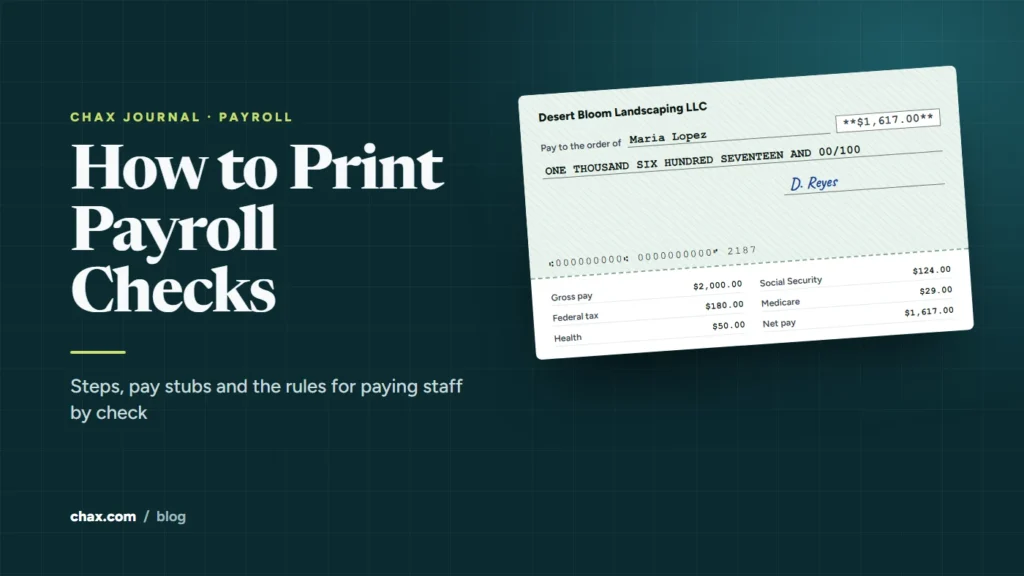
To print payroll checks, run payroll in your payroll or accounting software, then print the checks and pay stubs on blank voucher check stock with a laser printer and MICR toner. Sign the checks, pay employees on your payday, and keep the records for at least four years.
Federal law does not require pay stubs, but it does require accurate pay records. Employees cannot be forced into direct deposit at a bank they did not choose, so paper checks remain an option many employers need.
Why businesses still print payroll checks
Paper checks are still common in business: 83 percent of small firms used paper checks for business payments in the Federal Reserve’s 2024 business study.[1] For payroll, checks pay workers who do not have a bank account or do not want direct deposit. They also suit small or irregular payrolls, and they put the pay stub in the employee’s hand with the pay.
How to print payroll checks, step by step
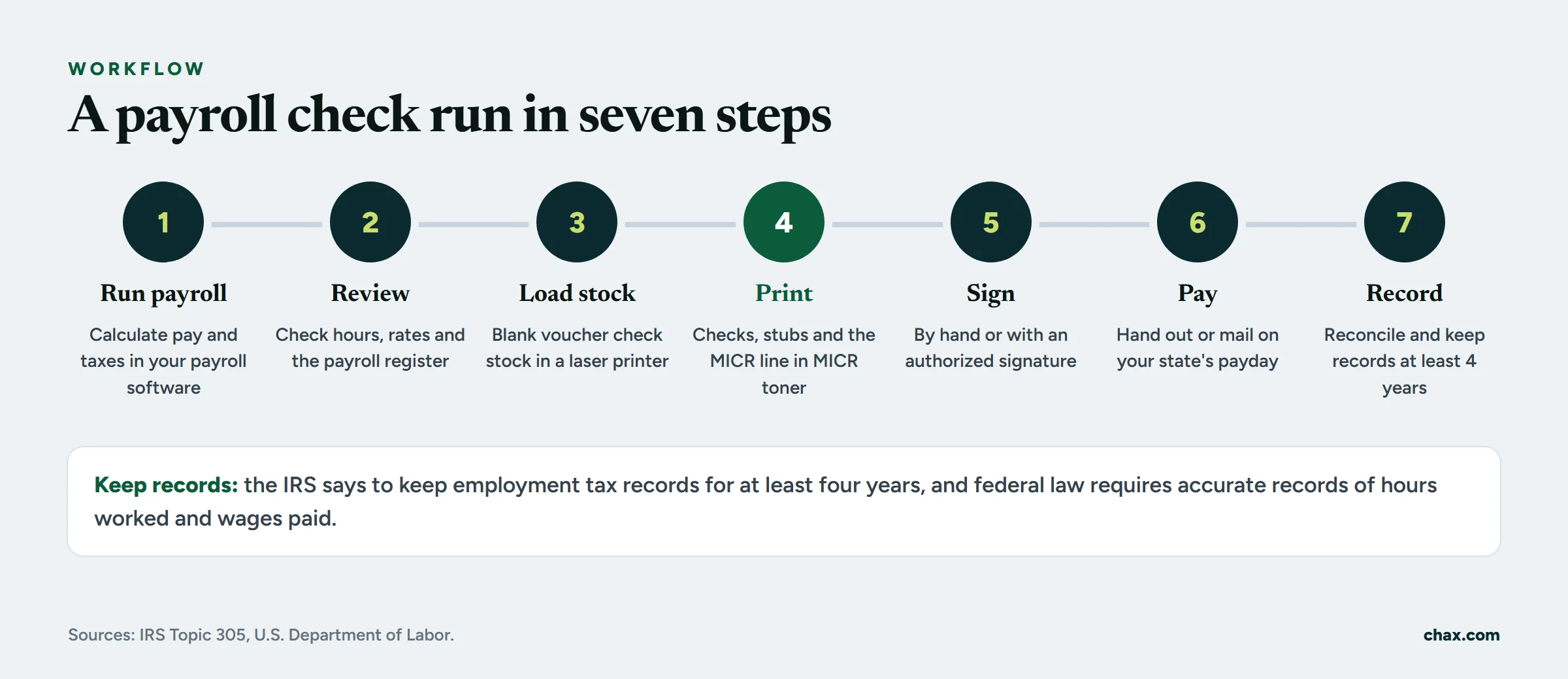
- Run payroll. Calculate hours, gross pay, taxes and deductions in your payroll or accounting software.
- Review the register. Check names, hours, rates and totals before anything prints.
- Load blank voucher stock. Use check stock with the check on top and two stubs below, in a laser printer.
- Print checks and stubs. The software prints your company and bank details, the employee, the net pay and the MICR line. Print the MICR line with MICR toner, which ANSI X9 standards cover.[12]
- Sign. Sign by hand, or use an authorized signature if your bank allows it.
- Pay on time. Hand out or mail checks on your regular payday. How often you must pay depends on your state.[4]
- Record and reconcile. Match cleared checks to your payroll register and keep the records.
What goes on a payroll check stub
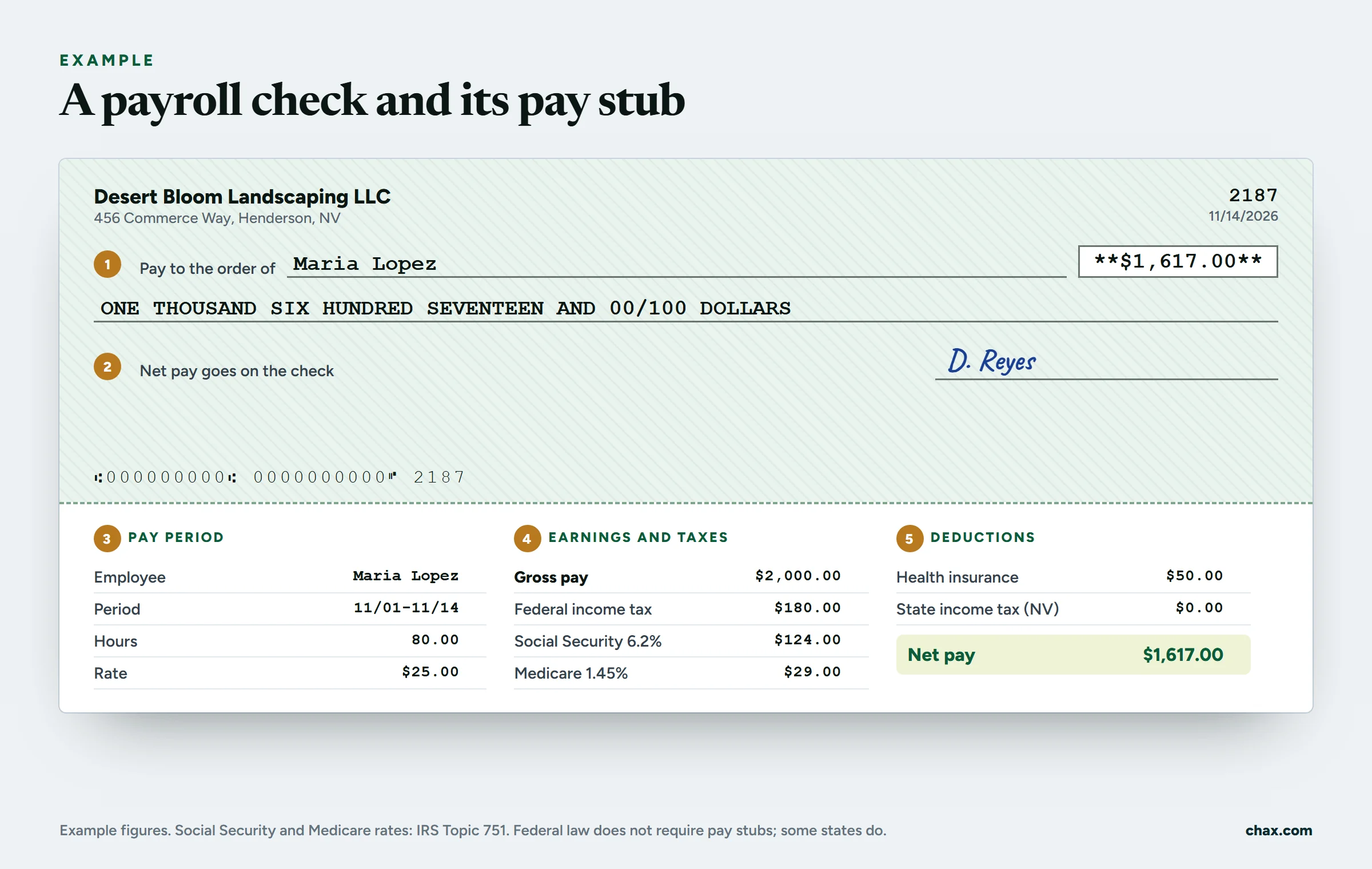
A voucher payroll check puts the check on top and the pay stub below it. The check shows the net pay, what the employee actually receives. The stub shows how you got there:
- Pay period, hours and rate
- Gross pay before taxes and deductions
- Taxes withheld: federal income tax, Social Security at 6.2 percent and Medicare at 1.45 percent of wages,[7] plus state and local taxes where they apply
- Deductions such as health insurance or retirement contributions
- Net pay and, usually, year-to-date totals
The federal Fair Labor Standards Act does not require employers to give pay stubs, but it does require accurate records of hours worked and wages paid.[2] There is no required form for those records.[3] Some states do require a written wage statement with each payment, so check your state’s labor department.
Paper paychecks, direct deposit or pay cards?
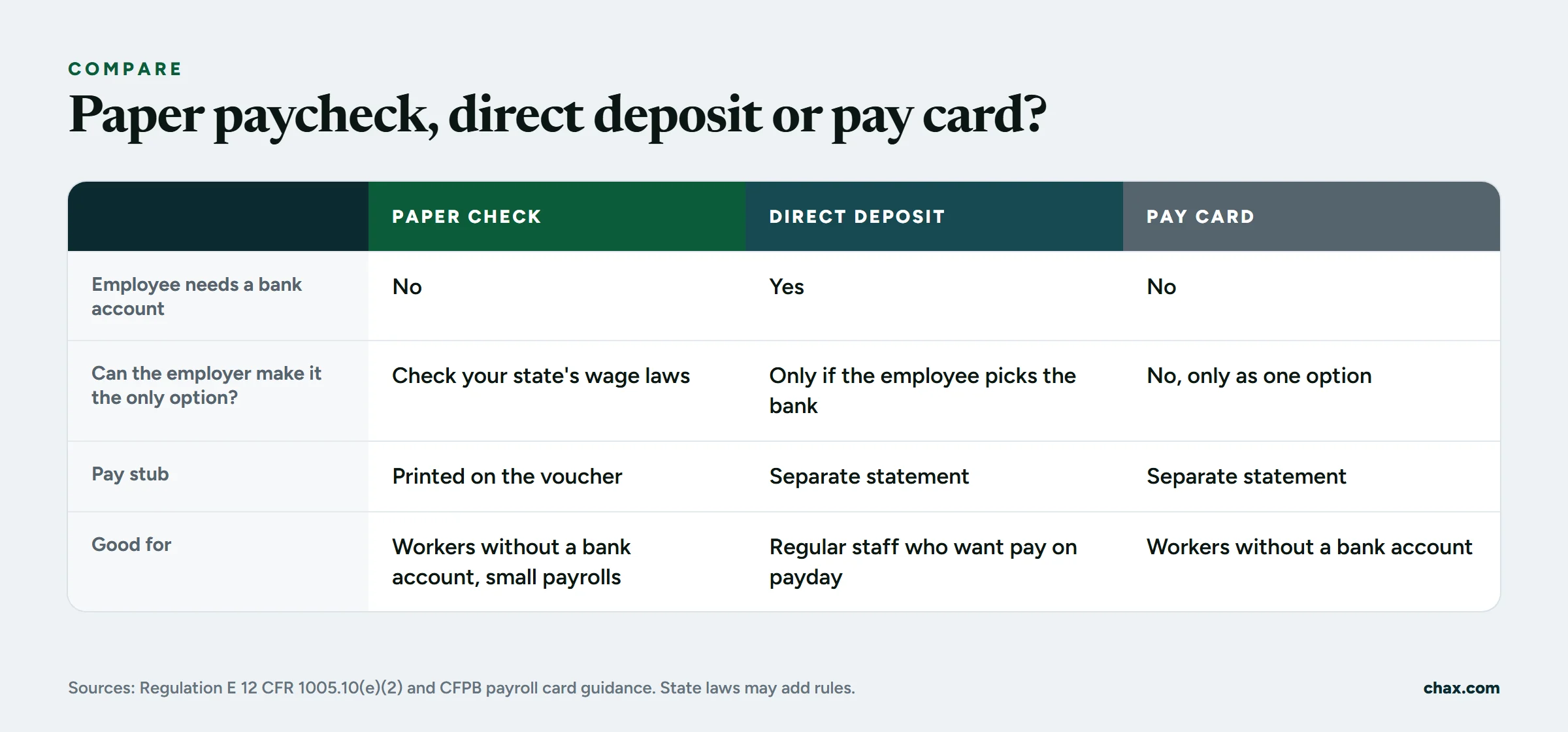
Under Regulation E, no employer may require employees to open an account at a particular bank to receive their pay.[5] An employer can require direct deposit only if employees choose the bank, or it can offer its own bank alongside another option such as a paper check. A payroll card can be offered, but only as one choice among others.[6] State wage laws may add their own rules, so many employers keep paper payroll checks available.
Blank payroll checks vs. pre-printed
Pre-printed voucher checks come printed with your company and bank details. Intuit lists Basic voucher checks at $224.99 for 500 and $317.99 for 1,000, and Secure Plus at $264.46 for 500.[10] Each box works for one bank account.
Blank voucher check stock has no bank details until you print. In the CHAX Store, 500 sheets cost $45.99 to $51.99, depending on the security level.[11] One stock covers every payroll and bank account, and nothing is scrapped when your bank or address changes. Compare the two with your own numbers in our blank stock vs. pre-printed calculator.
Keep payroll checks secure
Checks are the payment type most often hit by fraud: 63 percent of organizations reported attempted or actual check fraud in 2024.[9] For payroll:
- Lock up blank check stock and limit who can print and sign.
- Separate duties: the person who runs payroll should not also reconcile the bank account.
- Use check stock with security features, and print the MICR line with MICR toner.
- Reconcile the payroll account every pay period, and ask your bank which fraud protection services it offers.
Read how to prevent check fraud for more.
Keep payroll records
The IRS says to keep employment tax records for at least four years.[8] Federal law also requires accurate records of hours worked and wages paid for each employee.[3] Check printing software keeps a history of every check, so each payroll is easy to find and reprint if a check is lost.
Printing payroll checks from QuickBooks and other software
MultiCHAX 11 prints payroll checks from QuickBooks Desktop, Quicken and other programs that print checks: you print to the MultiCHAX printer, and it places each field on blank stock using your check template. For QuickBooks Online and programs that save checks as a PDF, MultiCHAX imports the PDF and keeps the voucher stubs. See QuickBooks check printing and MultiCHAX check printing software.
How to make payroll run smoother
A payroll check run is only as good as the payroll behind it. A few habits cut most of the time and errors:
- Use payroll software, not spreadsheets. It calculates withholding from current tax tables and keeps a record of every run.
- Connect time tracking and accounting. Approved hours flow into payroll, and each payroll posts to your books without retyping.
- Keep a payroll calendar. List paydays, cutoff dates for hours and your federal tax deposit dates. The IRS puts each employer on a monthly or semiweekly deposit schedule.[13]
- Offer direct deposit and checks. Employees who want direct deposit get it, and the rest get a check printed in the same run.
- Review before you print, reconcile after. Check the register before checks print, and match cleared checks to it every pay period.
- Consider a payroll service. Full-service payroll providers calculate, file and deposit payroll taxes for you. At CHAX we run payroll and print our paychecks in Gusto, and its integration sends the payroll data to QuickBooks Online.
Using QuickBooks Online Payroll? See how to print paychecks in QuickBooks Online.
Print your next payroll on blank stock. Every feature works in the free MultiCHAX 11 trial, and trial checks print with a DEMO mark.
Frequently asked questions
How do I print payroll checks?
Run payroll in your payroll or accounting software, review the register, load blank voucher check stock in a laser printer with MICR toner, and print the checks with their stubs. Sign them, pay employees on your payday, and keep the records.
Can I print payroll checks on blank check stock?
Yes. Check printing software prints your company and bank details, the MICR line and the pay stub on blank voucher stock, so one stock works for every payroll and bank account.
Do I have to give employees a pay stub?
Federal law does not require pay stubs, but it does require accurate records of hours worked and wages paid. Some states require a written wage statement, so check your state’s labor department.
Can I require employees to take direct deposit?
Not to a bank you choose. Under Regulation E, you can require direct deposit only if employees pick the bank, or you can offer your bank alongside another option such as a paper check. A payroll card can only be one option.
What goes on a payroll check stub?
Usually the pay period, hours and rate, gross pay, each tax withheld, deductions, net pay and year-to-date totals. Social Security is withheld at 6.2 percent and Medicare at 1.45 percent of wages.
How long do I keep payroll records?
The IRS says to keep employment tax records for at least four years.
Can I print payroll checks from QuickBooks?
Yes. QuickBooks Desktop can print to MultiCHAX, which places each field on blank stock using your template. For QuickBooks Online, save the checks as a PDF and MultiCHAX imports them with their voucher stubs.
Sources
- Federal Reserve Bank of Atlanta, “Why Do Businesses Still Use Paper Checks?” (Jan. 12, 2026), on the 2024 Federal Reserve Payments Insight Business Study
- U.S. Department of Labor, Questions and Answers About the Fair Labor Standards Act (pay stubs and records)
- U.S. Department of Labor, Recordkeeping and Reporting
- U.S. Department of Labor, State Payday Requirements
- CFPB, Regulation E 12 CFR 1005.10, preauthorized transfers (compulsory use)
- CFPB, Payroll Card Accounts (Regulation E) bulletin
- IRS, Topic no. 751, Social Security and Medicare withholding rates
- IRS, Topic no. 305, Recordkeeping
- Association for Financial Professionals, 2025 AFP Payments Fraud and Control Survey, press release (Apr. 15, 2025)
- Intuit Market, QuickBooks voucher checks, Basic and Secure Plus prices by quantity (checked Nov. 3, 2026)
- CHAX Store, blank business laser checks, 500 sheets (prices checked Nov. 2026)
- ANSI X9.100-20, print and test specifications for MICR (E-13B) characters
- IRS, Publication 15 (Circular E), Employer’s Tax Guide, deposit schedules
Last reviewed November 2026. Payroll and wage laws vary by state. This article is general information, not legal, tax or payroll advice.
