CHAX vs. ACH: Which is Right for Your Business?
When it comes to accepting payments directly from a customer’s bank account, there are two primary technologies that businesses consider: ACH (Automated Clearing House) and Remotely Created Checks, the technology that powers CHAX Check-by-Phone. While both achieve a similar goal—transferring funds from one bank account to another—they operate in fundamentally different ways. Understanding these differences is key to choosing the right solution for your business.
Neither technology is universally “better” than the other; they are simply designed for different use cases. This guide will provide an honest, side-by-side comparison to help you decide which system best fits your needs.
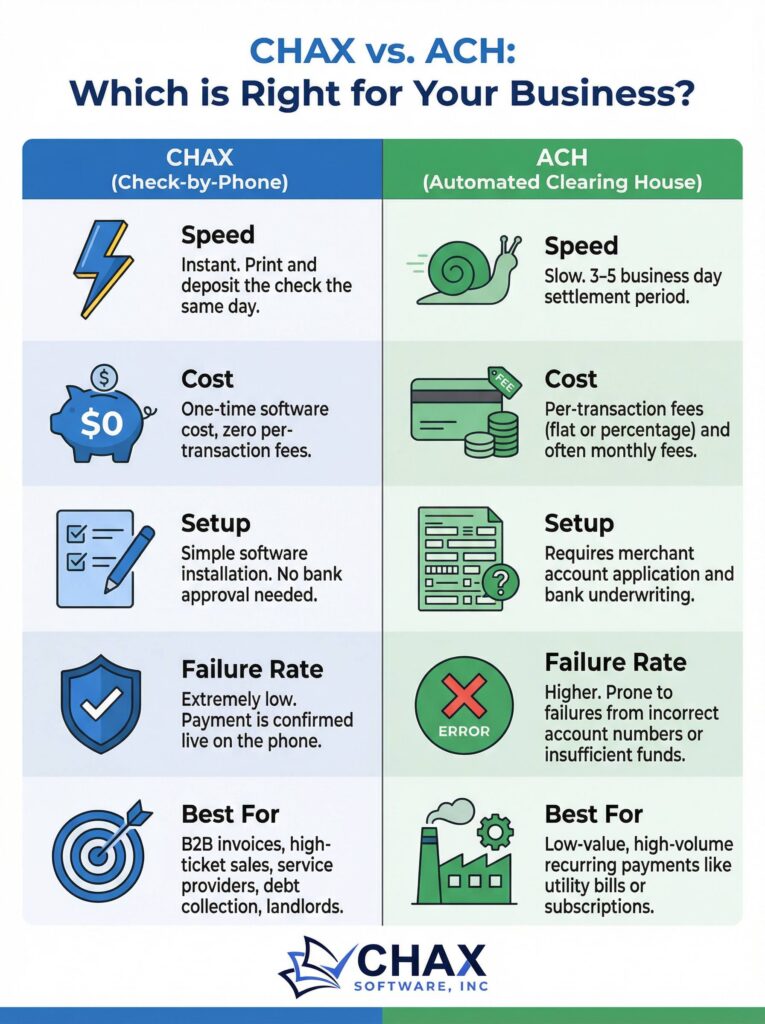
!CHAX vs. ACH: Which is Right for Your Business?

A Head-to-Head Comparison: CHAX vs. ACH
Let’s break down the key differences between these two payment methods.
| Feature | CHAX (Check-by-Phone) | ACH (Automated Clearing House) |
| :— | :— | :— |
| Speed | Instant. You print a physical check that can be deposited the same day. | Slow. Funds are transferred through a batching system that typically takes 3-5 business days to settle. |
| Cost | One-time software cost. There are zero per-transaction or monthly fees. | Recurring fees. Most ACH providers charge per-transaction fees (either flat or a percentage) and often a monthly account fee. |
| Setup | Simple. Requires a simple software installation on your computer. No application or bank approval is needed. | Complex. Requires applying for a merchant account, which involves a bank underwriting and approval process that can take days or weeks. |
| Failure Rate | Extremely low. Because you are confirming the bank details and payment authorization with the customer live on the phone, the chance of error is minimal. | Higher. ACH payments are more prone to failure due to typos in account numbers, insufficient funds (NSF), or closed accounts. Each failure can result in a chargeback fee. |
When to Choose CHAX Check-by-Phone
CHAX excels in situations where speed, cost-effectiveness, and certainty are the highest priorities. It is the ideal solution for:
- High-Ticket Invoices: For B2B sales, professional services, or any large transaction, avoiding a percentage-based fee by using CHAX can save you hundreds of dollars on a single payment.
- Service Providers & Contractors: If you need to collect payment upon completion of a job, CHAX allows you to get paid on the spot before you even leave the premises.
- Debt Collection & Landlords: In industries where securing a firm payment commitment is crucial, the live phone authorization of CHAX is far more reliable than a delayed ACH pull that might fail.
- Businesses Needing Simplicity: If you want to avoid the lengthy application process of an ACH merchant account, CHAX can be set up and ready to use in minutes.
When to Choose ACH
ACH is built for high-volume, low-value, automated recurring transactions. It is often the better choice for:
- Subscription Services: For businesses charging a large number of customers a small, fixed amount each month (e.g., a $10/month software subscription), the automation of ACH is highly efficient.
- Utility Bills: Companies that bill thousands of customers for variable amounts each month rely on the automated, batch-processing nature of the ACH network.
- Payroll Direct Deposit: The ACH network is the standard for paying employees via direct deposit.
The Verdict: Choose the Right Tool for the Job
For many businesses, the answer isn’t choosing one over the other, but using both strategically. You might use ACH for your small, recurring monthly clients, but use CHAX to collect large initial setup fees, settle high-value invoices, or as a fallback when a customer’s credit card or ACH payment fails.
By understanding the core strengths of each system, you can build a payment processing strategy that is fast, cost-effective, and perfectly tailored to the needs of your business. If speed, simplicity, and eliminating transaction fees are your priorities, CHAX is the clear winner.