
How to Securely Take Payment Information Over the Phone (TCPA/PCI Best Practices)
Taking payment information over the phone is a common and legally sound practice for millions of businesses. However, it comes with a responsibility to handle sensitive financial information with the utmost care. Customers are trusting you with their bank account details, and a breach of that trust — or a failure to follow proper procedures — can have serious legal and reputational consequences.
This guide provides a practical, step-by-step checklist for taking phone payments securely and in compliance with relevant regulations, including the Telephone Consumer Protection Act (TCPA) and Payment Card Industry (PCI) best practices.
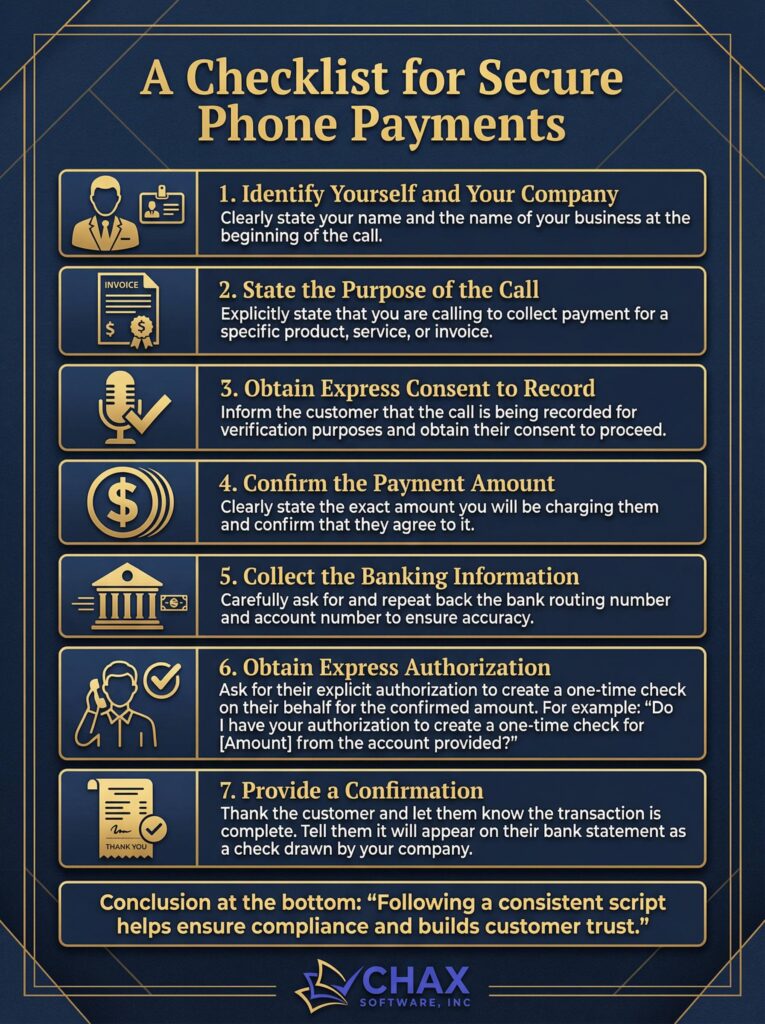
!A Checklist for Secure Phone Payments

Why Security and Compliance Matter
Before diving into the checklist, it’s worth understanding the stakes. Two key regulatory frameworks govern how businesses handle phone-based payment collection:
- The Telephone Consumer Protection Act (TCPA): This federal law governs how businesses can contact consumers by phone. It requires that you have proper consent to contact customers and that you honor do-not-call requests. Violations can result in significant fines.
- PCI DSS (Payment Card Industry Data Security Standard): While primarily focused on credit card data, the principles of PCI DSS — protecting sensitive financial information, not storing data unnecessarily, and maintaining secure systems — are best practices that apply to all forms of payment data, including bank account information.
The 7-Step Checklist for a Secure Phone Payment
Following a consistent script for every call is the single most important thing you can do to ensure compliance and build customer confidence.
Step 1: Identify Yourself and Your Company. Begin every call by clearly stating your full name and the name of your business. This establishes transparency and helps the customer confirm they are speaking with a legitimate representative.
Step 2: State the Purpose of the Call. Explicitly state that you are calling to collect payment for a specific product, service, or invoice. Reference the invoice number or service description so the customer can immediately identify what the payment is for.
Step 3: Obtain Express Consent to Record. Before proceeding, inform the customer that the call is being recorded for verification and quality purposes, and obtain their consent to continue. This recording serves as your authorization record and is a critical compliance requirement.
Step 4: Confirm the Payment Amount. Clearly state the exact dollar amount you will be processing. Ask the customer to confirm they agree to this amount before you collect any banking information.
Step 5: Collect the Banking Information Carefully. Ask for the bank routing number and account number. As you receive each piece of information, repeat it back to the customer to confirm accuracy. A single digit error can result in a failed or misdirected payment.
Step 6: Obtain Express Authorization. This is the most critical step. Ask the customer a direct question to obtain their explicit authorization. A recommended script is: “Do I have your authorization to create a one-time check for [Amount] from the account ending in [Last 4 Digits]?” Their affirmative response, captured on the recording, is your legal authorization.
Step 7: Provide a Confirmation. Close the transaction professionally. Thank the customer, confirm the transaction is complete, and let them know the payment will appear on their bank statement as a check drawn by your company. This prevents confusion and reduces the likelihood of a dispute.
Protecting the Data After the Call
Your security obligations do not end when the call does. Following these practices will protect your business and your customers:
- Do not write down full account numbers on paper that could be seen by others.
- Do not store sensitive banking information in unsecured files, spreadsheets, or email.
- Limit access to payment records to only the staff members who need it.
- Retain authorization recordings for a minimum of two years to defend against any potential disputes.
By following this checklist consistently, you create a secure, professional, and legally defensible payment collection process. CHAX Check-by-Phone is the tool that makes this process efficient — your adherence to these best practices is what makes it trustworthy.