
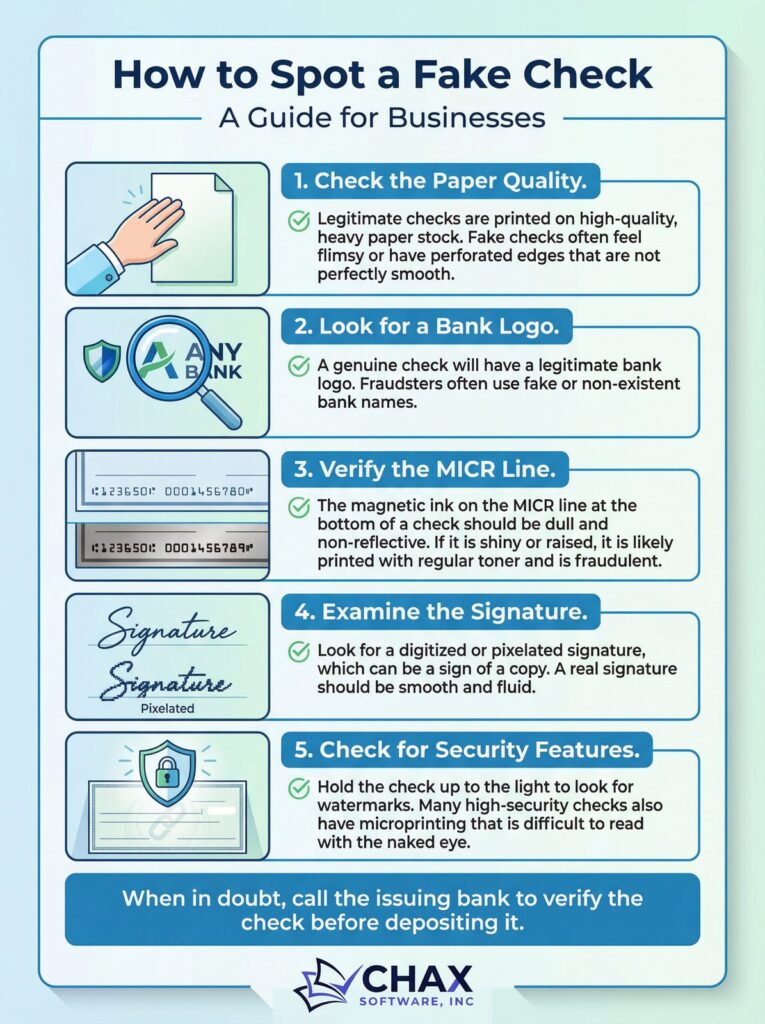
# How to Spot a Fake Check: A Guide for Businesses
Fake checks are one of the oldest and most persistent forms of financial fraud. While digital payment scams dominate the headlines, counterfeit and altered checks continue to cause significant losses for businesses every year. The consequences of accepting a fraudulent check can be severe: your bank may hold you liable for the full amount, even after the check has been deposited and the funds appear in your account.
Knowing how to identify a fake check before you deposit it is an essential skill for any business owner. This guide walks you through the five most reliable indicators that a check may be fraudulent.

## 5 Red Flags That a Check May Be Fake
### 1. Check the Paper Quality
The first thing to do when you receive a check is to feel it. Legitimate business checks are printed on high-quality, heavy paper stock that has a distinct weight and texture. Counterfeit checks are often printed on standard copy paper or thin cardstock, which feels noticeably lighter and flimsier.
Pay particular attention to the perforated edges. Checks from a legitimate checkbook will have clean, evenly perforated edges. A check that has been printed on a home printer and cut with scissors will have straight, smooth edges with no perforations — a clear red flag.
### 2. Look for a Legitimate Bank Logo and Address
Every legitimate check will display the name and logo of the issuing bank, along with the bank’s address. Examine this information carefully. Fraudsters often create checks using the names of non-existent banks, or they may use a real bank’s name but with a slightly altered logo or a fake address.
If you are unfamiliar with the bank listed on the check, do not simply Google the bank name — fraudsters can create convincing fake websites. Instead, look up the bank’s phone number independently through the FDIC’s BankFind tool and call them directly to verify the check.
### 3. Verify the MICR Line
The row of numbers at the bottom of a check — the routing number, account number, and check number — is printed with MICR (Magnetic Ink Character Recognition) toner. This magnetic ink has a distinctive appearance: it is **dull and non-reflective**. If the numbers at the bottom of a check appear shiny, raised, or have a glossy finish, they were almost certainly printed with regular laser toner, which is a strong indicator that the check is fraudulent.
You can also run your finger lightly over the MICR line. Genuine MICR toner has a slightly rough, tactile feel due to the iron oxide particles. Regular toner feels smooth and plastic-like.
### 4. Examine the Signature
A legitimate check will have a handwritten signature that is smooth and fluid. Look closely at the signature — if it appears digitized, pixelated, or printed (rather than handwritten), it is likely a copy or a computer-generated forgery. Many fraudulent checks are created by scanning a legitimate check and then altering the payee name and amount using image editing software, which often leaves telltale signs of digital manipulation around the signature area.
### 5. Look for Security Features
Hold the check up to a light source and look for a watermark. Most legitimate business checks and all personal checks from major banks include a watermark that is visible when backlit. If no watermark is visible, treat the check with suspicion.
Also examine the signature line closely with a magnifying glass. Many high-security checks include microprinting — tiny text that appears as a solid line to the naked eye but is readable under magnification. If the check has been photocopied or scanned, the microprinting will appear as a blurred, indistinct line rather than readable text.
## The Golden Rule: When in Doubt, Verify
If you have any doubts about a check you have received, do not deposit it until you have verified its authenticity. Call the issuing bank directly — using a phone number you have looked up independently, not one printed on the check — and ask them to confirm that the check is valid and that the account has sufficient funds. This simple step can save your business from a potentially devastating loss.