
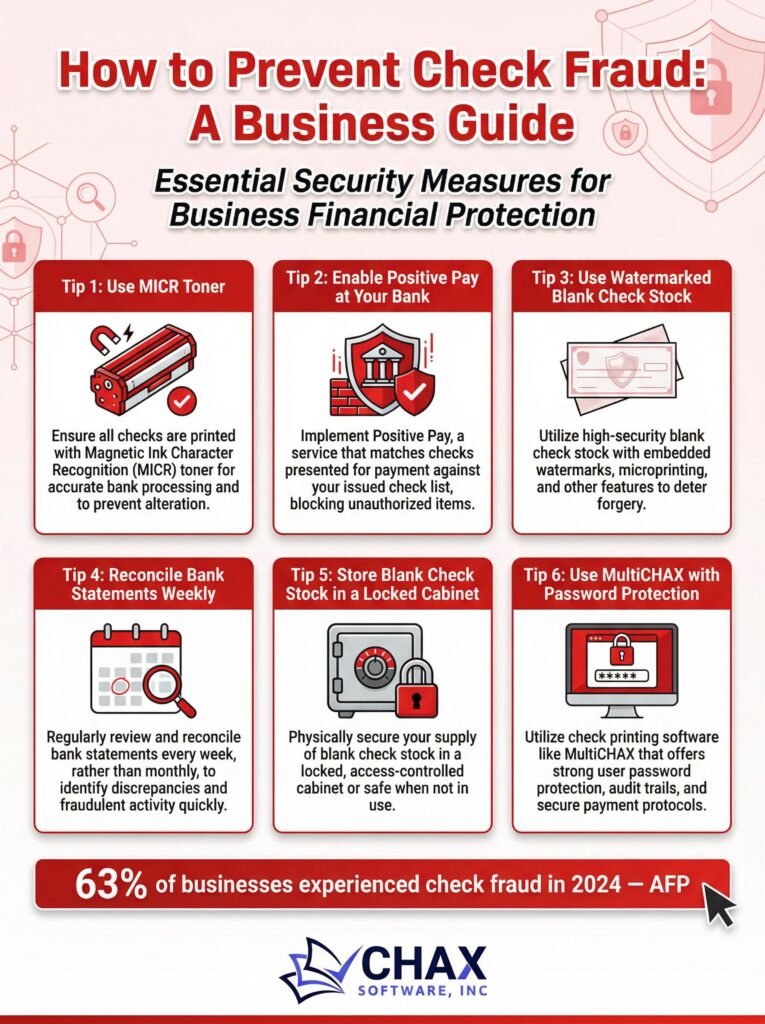
How to Prevent Check Fraud: A Guide for Small Businesses
Check fraud remains one of the most common and costly forms of financial crime targeting small businesses. From stolen checkbooks to sophisticated forgery, the methods used by criminals are constantly evolving. However, by implementing a series of straightforward security measures, you can dramatically reduce your company’s vulnerability to check fraud.
This guide provides a checklist of essential practices to protect your business.
The Most Important Step: Stop Using Pre-Printed Checks
If you do only one thing, do this. Using pre-printed check stock from your bank or accounting software provider is the single biggest security risk in the payment process. Each check contains your bank account number, routing number, and company information. A stolen box of these checks is a direct line into your bank account.
The Solution: Switch to printing your checks on demand onto blank check stock. A secure check printing software like MultiCHAX will print all the check elements—including the bank information and MICR line—at the moment of printing. This renders the blank paper worthless until it is used, eliminating the risk of stolen checkbooks.
Implement Positive Pay with Your Bank
Positive Pay is one of the most effective anti-fraud services offered by banks. Here’s how it works:
1. Each time you run a check batch, you send a file to your bank containing the check numbers, issue dates, and exact dollar amounts of all the checks you printed.
2. When a check is presented to your bank for payment, the bank’s system automatically compares it against your submitted file.
3. If the check number and dollar amount do not exactly match a record in your file, the bank flags it as a fraudulent item and will not pay it. This instantly defeats any attempt to alter the payee or the amount on a legitimate check.
Use High-Security Blank Check Stock
Not all blank check stock is created equal. When purchasing paper, look for stock that includes multiple security features:
- Watermarks: A faint image that can only be seen when held up to the light.
- Microprinting: Tiny text that is very difficult to copy or scan accurately.
- Chemically Reactive Paper: Paper that will show a visible stain or mark if a criminal tries to use chemicals to “wash” the ink off a check.
- Holographic Seals: A three-dimensional foil image that is nearly impossible to forge.
Print with MICR Toner
Using a MICR (Magnetic Ink Character Recognition) toner cartridge in your laser printer is essential for bank compliance. But it also serves as a security feature. The magnetic ink is difficult for criminals to replicate, and checks printed without it are often subject to greater scrutiny by banks.
Establish Strong Internal Controls
Technology is only part of the solution. Your internal processes are just as important.
- Segregation of Duties: The person who can approve a payment should not be the same person who can print and sign the check. This simple separation makes it much harder for an employee to commit fraud.
- Secure Check Storage: Store your blank check stock in a locked cabinet or safe, just as you would with pre-printed checks.
- Use Digital Signatures with Password Protection: If you use a digital signature for efficiency, ensure your QuickBooks check printing software allows you to password-protect the signature file. This prevents unauthorized employees from printing signed checks.
- Reconcile Your Bank Accounts Promptly: Reconcile your accounts at least weekly. The sooner you spot a fraudulent transaction, the higher the chance you have of recovering the funds.
By combining modern technology like blank check printing and Positive Pay with strong internal processes, you can create a multi-layered defense that makes your business a much harder target for fraudsters.