
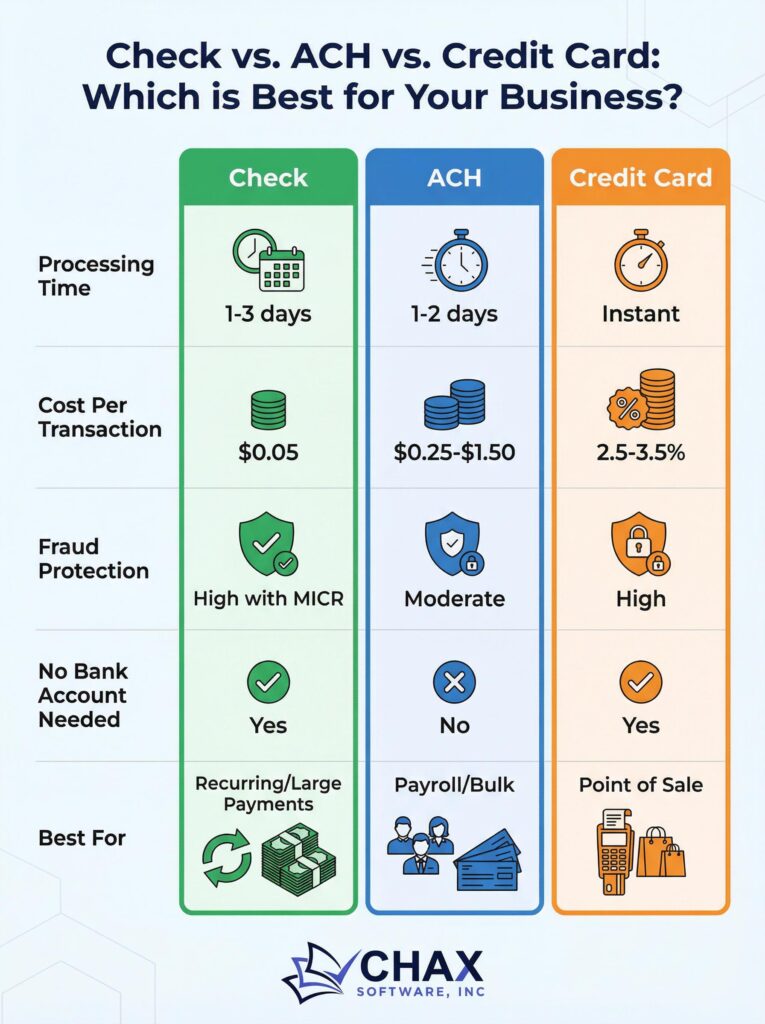
Check vs. ACH vs. Credit Card: Which Payment Method is Best for Your Business?
Choosing the right payment methods for your business is a strategic decision that impacts cash flow, operational efficiency, and your bottom line. The three most common methods for business-to-business (B2B) payments are paper checks, ACH transfers, and credit cards. Each has distinct advantages and disadvantages.
This guide will break down the pros and cons of each method to help you decide on the optimal payment mix for your company.
1. Paper Checks
Despite the rise of digital payments, the paper check remains a resilient and widely used payment method in the B2B world. Modern technology has made check printing more secure and efficient than ever before.
Pros:
- Universally Accepted: Every business and bank in the country accepts checks.
- Low Transaction Cost: The cost to issue a check is minimal, especially when printing on blank check stock. There are no percentage-based fees.
- Rich Remittance Data: A check voucher can contain detailed information about the invoices being paid, which simplifies reconciliation for your vendor.
- Control Over Timing: You control exactly when the payment is sent, and funds are not debited from your account until the check is cashed.
Cons:
- Manual Process: Can be slow to print, sign, and mail if you are not using an efficient workflow.
- Risk of Mail Delay or Loss: Checks can get lost in the mail, delaying payment.
- Security Risks (if using pre-printed stock): Using pre-printed checks is a major security risk. This is easily solved by using a secure check printing software with blank stock.
Best for: Businesses looking for a low-cost, universally accepted payment method, especially when paying vendors who prefer traditional payments or require detailed remittance information.
2. ACH (Automated Clearing House) Payments
ACH is an electronic network for moving money between bank accounts in the United States. It is the primary method used for direct deposit and recurring bill payments.
Pros:
- Low Cost: ACH payments are very inexpensive, often costing just a few cents per transaction.
- Highly Reliable: The electronic transfer is secure and reliable, with very low failure rates.
- Easy to Automate: Ideal for recurring payments like rent or subscription fees.
Cons:
- Slower Processing Time: A standard ACH transfer can take 2-3 business days to settle. While same-day ACH is available, it often costs more.
- Requires Vendor Bank Information: You must collect and securely store your vendor’s bank account and routing numbers, which can be a data security burden.
- Potential for Reversals: ACH payments can sometimes be reversed, which can create accounting complexities.
Best for: Recurring, predictable payments to trusted vendors and for direct deposit payroll.
3. Credit Cards
Credit cards offer speed and convenience but come at a significant cost, especially for the receiving party.
Pros:
- Instantaneous Payment: The payment is authorized immediately, and the funds are guaranteed to the vendor.
- Potential for Rewards: Your business may earn cash back or travel rewards on its credit card spending.
- Easy to Use: Most vendors are set up to accept credit card payments.
Cons:
- High Transaction Fees: This is the biggest drawback. Vendors are charged interchange fees that typically range from 2% to 4% of the transaction value. Many vendors will pass this cost on to you or refuse to accept credit cards for large payments.
- Lower Security for Large Transactions: The risk of credit card fraud is high, and credit limits can be a constraint for large B2B payments.
Best for: Small, urgent purchases where the convenience outweighs the high transaction cost.
The Optimal Strategy: A Hybrid Approach
For most businesses, the best strategy is not to choose one method, but to use a hybrid approach:
- Use ACH for recurring payments and payroll.
- Use Credit Cards for small, ad-hoc purchases.
- Use Checks for the bulk of your vendor payments. By using a modern QuickBooks check printing software to print on blank stock, you get the best combination of low cost, universal acceptance, and high security.
By leveraging the strengths of each payment method, you can create a flexible, secure, and cost-effective accounts payable strategy that supports your business’s growth.