
# What is Positive Pay and Do You Need It?
If you have ever had a check stolen, altered, or counterfeited, you already understand the devastating impact that check fraud can have on a business. If you haven’t, consider yourself fortunate — but don’t assume your luck will hold. Check fraud is at an all-time high, and businesses of every size are targets. Positive Pay is the most powerful tool available to stop it, and yet many business owners have never heard of it.
This guide will explain exactly what Positive Pay is, how it works, and help you determine whether your business needs it.

## What is Positive Pay?
Positive Pay is a cash management service offered by most commercial banks. It is designed to prevent check fraud by creating a verification layer between the checks you issue and the checks your bank pays. In essence, it gives you the ability to pre-authorize every check before it is paid from your account.
The concept is straightforward: you tell your bank which checks you have written, and the bank only pays those exact checks. Any check that does not match your records is flagged for your review before any money leaves your account.
## How Does Positive Pay Work? A 4-Step Process
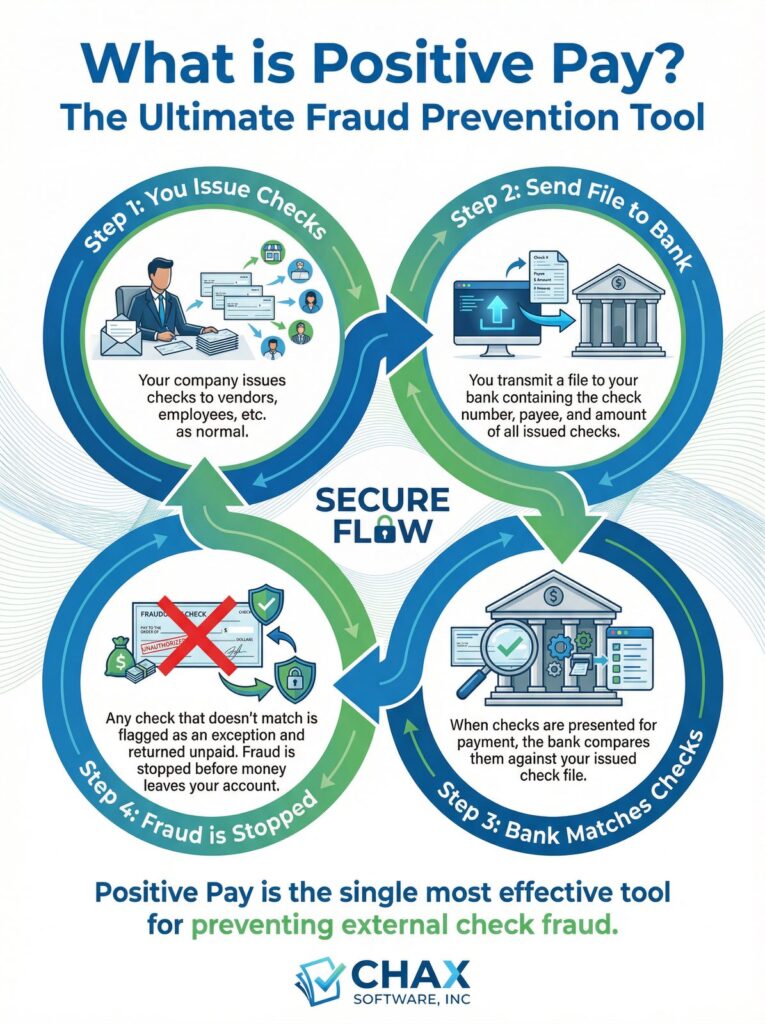
The Positive Pay process follows a simple, repeatable cycle.
**Step 1: You Issue Checks.** Your business issues checks to vendors, employees, or any other payees as part of your normal operations. Nothing changes in your day-to-day check writing process.
**Step 2: You Send a File to Your Bank.** Each time you issue a batch of checks, you transmit a data file to your bank. This file contains the key details of each check: the check number, the payee name, and the exact dollar amount. Many check printing software programs, including MultiCHAX, can generate this file automatically.
**Step 3: The Bank Matches Incoming Checks.** When a check is presented to your bank for payment — whether it is deposited at a branch, processed through an ATM, or cleared electronically — the bank’s system automatically compares the presented check against your issued check file.
**Step 4: Exceptions Are Flagged.** If a presented check does not match your file in any way — the amount is different, the check number was never issued, or the payee name doesn’t match — the bank flags it as an exception. You will receive a notification (typically via your online banking portal) and have the opportunity to review the check image and decide whether to pay or return it.
## Does Your Business Need Positive Pay?
The short answer is: if your business issues checks regularly, yes. The cost of Positive Pay is typically a small monthly fee charged by your bank — often between $25 and $100 per month — which is a fraction of the cost of a single successful fraud incident.
Positive Pay is particularly essential for businesses that:
* Issue a high volume of checks to multiple vendors or payees.
* Have experienced check fraud or theft in the past.
* Mail checks, as mailed checks are the most common target for theft and washing.
* Have multiple authorized signatories on their bank accounts.
## How MultiCHAX Supports Positive Pay
MultiCHAX is designed to work seamlessly with Positive Pay programs. The software can generate the issued check data file in the format required by most major banks, making the process of submitting your check register to the bank quick and straightforward. This integration removes the manual effort from the Positive Pay process and ensures that your bank always has an accurate, up-to-date record of every check you issue.
Implementing Positive Pay alongside MultiCHAX creates a complete, end-to-end check security system that protects your business at every stage of the payment process — from the moment a check is printed to the moment it clears your bank.