
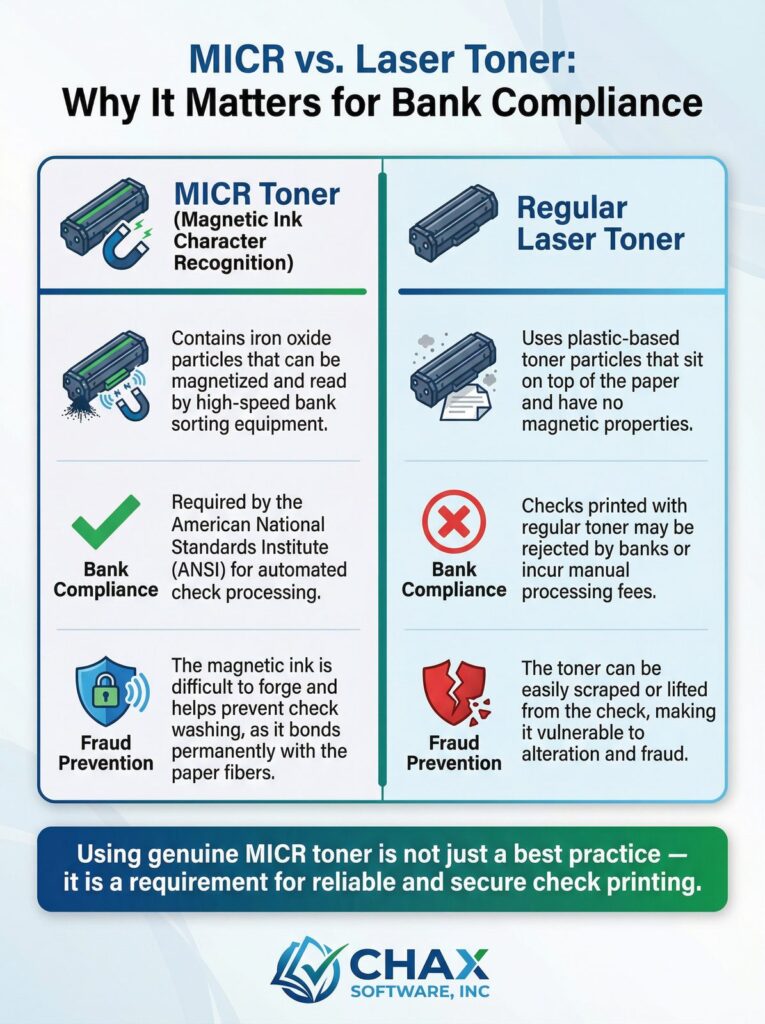
# MICR vs. Laser Toner: Why It Matters for Bank Compliance and Check Security
When businesses first start printing their own checks using software like CHAX or MultiCHAX, one of the most common questions is: “Can I just use the toner that’s already in my printer?” The answer is a firm no — and understanding why is critical to ensuring your checks are processed correctly by banks and are protected against fraud.
The difference between MICR toner and regular laser toner is not just a technicality. It is the difference between a check that is bank-compliant and secure, and one that may be rejected, delayed, or vulnerable to alteration.

## What is MICR Toner?
MICR stands for **Magnetic Ink Character Recognition**. It is a technology that has been used by the banking industry since the 1950s to enable the high-speed, automated processing of checks. The key ingredient that makes MICR toner unique is **iron oxide** — tiny magnetic particles that are suspended within the toner.
When a check is printed with MICR toner, the characters at the bottom of the check (the routing number, account number, and check number) are encoded with these magnetic particles. High-speed bank sorting machines use magnetic read heads to scan and interpret these characters, enabling banks to process millions of checks per day with exceptional accuracy and speed.
## The Head-to-Head Comparison
The differences between MICR toner and regular laser toner extend across three critical dimensions.
| Feature | MICR Toner | Regular Laser Toner |
| :— | :— | :— |
| **Composition** | Contains iron oxide particles that can be magnetized | Uses plastic-based polymer particles with no magnetic properties |
| **Bank Compliance** | Required by ANSI standards for automated check processing | Checks may be rejected or incur manual processing fees |
| **Fraud Resistance** | Bonds permanently with paper fibers; highly resistant to chemical washing | Sits on top of paper fibers; can be scraped or dissolved by fraudsters |
### Bank Compliance
The American National Standards Institute (ANSI) and the banking industry have established clear standards for check printing. These standards require that the MICR line — the row of numbers at the bottom of a check — be printed with magnetic ink that meets specific signal strength requirements. A check printed with regular laser toner will fail this requirement.
In practice, this means that checks printed with regular toner may be rejected outright by some banks, or they may be pulled out of the automated processing stream and handled manually. Manual processing takes longer and often incurs additional fees charged back to the depositing bank, which may in turn be passed on to you.
### Fraud Resistance
This is where the security difference becomes most stark. Regular laser toner particles are plastic-based and sit on top of the paper’s surface. A fraudster can use common household chemicals — acetone, bleach, or specialized check-washing solutions — to dissolve or lift this toner from the paper, leaving a blank check that can be rewritten for any amount and to any payee.
MICR toner, by contrast, contains iron oxide particles that fuse and bond directly with the paper fibers during the printing process. This physical bond makes it significantly more resistant to chemical washing. While no security measure is completely foolproof, MICR toner provides a substantially higher level of protection against this common form of check fraud.
## Using MICR Toner with CHAX and MultiCHAX
CHAX and MultiCHAX are designed to work with MICR toner cartridges on standard HP LaserJet printers. The software handles the precise positioning and formatting of the MICR line, while the MICR toner cartridge provides the magnetic ink required for bank processing. Together, they create a complete, bank-compliant check printing solution.
Using genuine MICR toner is not an optional upgrade — it is a fundamental requirement for printing checks that will be accepted and processed correctly by the banking system. It is also one of the most cost-effective security investments your business can make.