# The Business Owner’s Guide to Check Security Features
Not all checks are created equal. The difference between a standard blank check and a high-security blank check can mean the difference between a payment that is processed smoothly and securely, and one that becomes the target of fraud. For business owners who print their own checks using software like CHAX or MultiCHAX, understanding the security features built into high-quality blank check stock is essential knowledge.
This guide breaks down the six most important check security features, explains how each one works, and helps you understand why they matter for your business.

## Why Check Security Features Matter
Check fraud cost U.S. businesses billions of dollars last year, and the most common attack vectors — check washing, counterfeiting, and alteration — can all be significantly deterred by using high-security check stock. When you print your own checks on blank stock, you have the opportunity to choose paper with the security features that best protect your business. Understanding what those features are is the first step.
## The Six Key Security Features
### 1. Chemically Reactive Security Paper
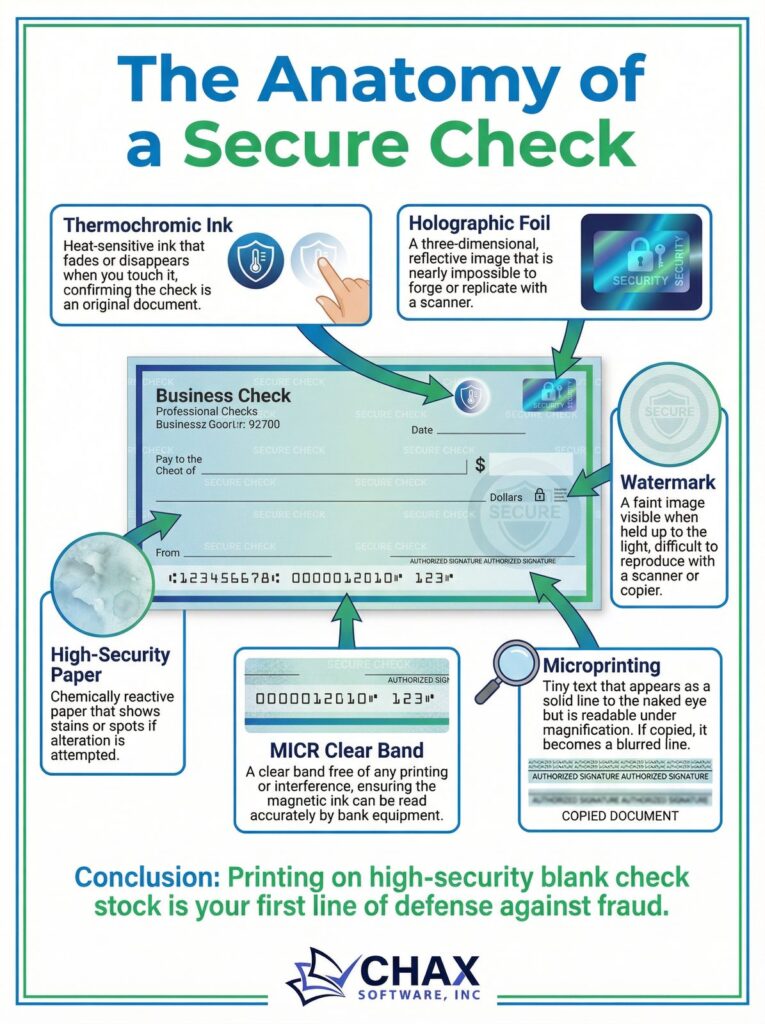
The most fundamental security feature is the paper itself. High-security check stock is manufactured with chemicals embedded in the paper fibers that react visibly when they come into contact with the solvents commonly used in check washing attacks. If a fraudster attempts to use bleach, acetone, or other chemicals to erase the ink on the check, the paper will develop visible stains, spots, or discoloration — making the alteration immediately apparent to anyone who examines the check.
This chemically reactive paper is the foundation upon which all other security features are built. Without it, even the most sophisticated printed security features can be defeated.
### 2. Watermarks
A watermark is a faint image or pattern that is embedded into the paper during the manufacturing process. It is visible when the check is held up to a light source, but is not visible under normal viewing conditions. Because watermarks are created during paper manufacturing — not during printing — they are extremely difficult to reproduce with a scanner, photocopier, or inkjet printer.
When examining a check for authenticity, holding it up to the light to check for a watermark is one of the quickest and most reliable verification methods available.
### 3. Microprinting
Microprinting is text that is printed at an extremely small size — typically less than one point — along the signature line or border of a check. To the naked eye, microprinting appears as a solid line or a decorative border element. Under magnification, however, it resolves into readable text, often repeating a phrase like “ORIGINAL DOCUMENT” or the name of the issuing company.
The security value of microprinting lies in what happens when a check is photocopied or scanned: the tiny text cannot be reproduced at that scale and instead appears as a blurred, indistinct line. This makes it an immediate indicator that a check is a copy rather than an original.
### 4. Holographic Foil
Some premium check stocks include a small holographic foil element — a reflective, three-dimensional image that shifts in appearance as the viewing angle changes. Holographic foil is one of the most difficult security features to replicate, as it requires specialized manufacturing equipment that is not accessible to fraudsters.
While holographic foil adds to the cost of blank check stock, it provides a highly visible and nearly impossible-to-forge authentication element that is immediately recognizable to bank tellers and recipients.
### 5. Thermochromic Ink
Thermochromic ink is heat-sensitive ink that changes color or disappears when touched. On a check, it is typically printed as a small icon or the word “ORIGINAL” in a specific location. When you press your finger against it, the warmth from your skin causes the ink to fade or disappear temporarily, confirming that the check is an original printed document rather than a photocopy.
This feature is particularly useful for quick, in-person verification of a check’s authenticity — a bank teller or business owner can confirm the check is genuine in seconds.
### 6. The MICR Clear Band
The MICR clear band is a specific area at the bottom of the check that must be kept completely free of any printing, marks, or interference. This clear band is where the MICR line — the routing number, account number, and check number — is printed with magnetic MICR toner. Bank sorting equipment reads this area magnetically, and any stray marks or printing in this zone can cause misreads, processing errors, or outright rejection of the check.
CHAX and MultiCHAX are specifically designed to ensure that all check elements are positioned correctly, keeping the MICR clear band free and ensuring your checks meet all banking standards for automated processing.
## Choosing the Right Check Stock for Your Business
When selecting blank check stock for use with CHAX or MultiCHAX, look for stock that includes at minimum: chemically reactive paper, a watermark, and microprinting. These three features provide a solid baseline of security for most businesses. Higher-risk businesses — those that issue large-dollar checks or have experienced fraud in the past — should consider stock that also includes holographic foil and thermochromic ink.
Combining high-security check stock with MICR toner and CHAX’s bank-compliant printing software creates a layered security system that addresses the most common check fraud attack vectors and gives your business the strongest possible protection.